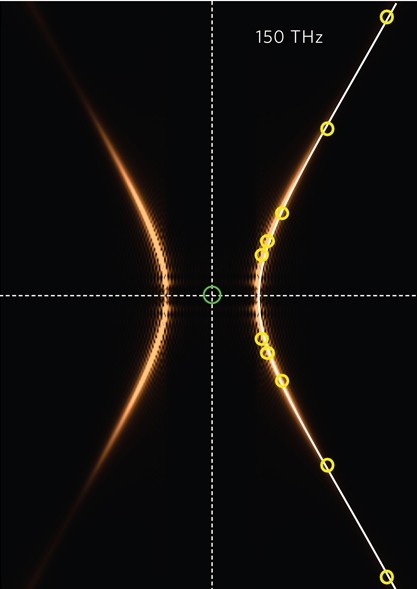
Indefinite optical cavities feature a hyperboloid iso-frequency contour that supports ultrahigh optical refractive indices. This cross-section shows the IFC (bronze curves) for a silver/germanium metamaterial with yellow circles representing cavity wave vectors and the green circle representing the light cone of air. (Courtesy of Xiang Zhang group)
The world's smallest three-dimensional optical cavities with the potential to generate the world's most intense nanolaser beams have been created by a scientific team led by researchers with the U.S. Department of Energy (DOE)'s Lawrence Berkeley National Laboratory (Berkeley Lab) and the University of California (UC) Berkeley. In addition to nanolasers, these unique optical cavities with their extraordinary electromagnetic properties should be applicable to a broad range of other technologies, including LEDs, optical sensing, nonlinear optics, quantum optics and photonic integrated circuits. By alternating super-thin multiple layers of silver and germanium, the researchers fabricated an "indefinite metamaterial" from which they created their 3D optical cavities. In natural materials, light behaves the same no matter what direction it propagates. In indefinite metamaterials, light can actually be bent backwards in some directions, a property known as negative refraction. The use of this indefinite metamaterial enabled the scaling down of the 3D optical cavities to extremely deep subwavelength (nanometer) size, resulting in a "hyperboloid iso-frequency contour" of light wave vectors (a measure of magnitude and direction) that supported the highest optical refractive indices ever reported. This study was directed by Xiang Zhang, a principal investigator with Berkeley Lab's Materials Sciences Division and director of UC Berkeley's Nano-scale Science and Engineering Center (SINAM).
TO READ THIS ARTICLE, CREATE YOUR ACCOUNT
And extend your reading, free of charge and with no commitment.