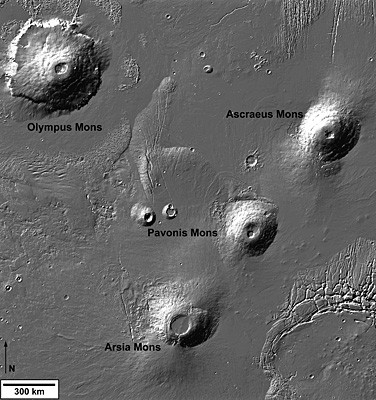
Tharsis Montes trio and Olympus Mons
First Mars Express gravity results plot volcanic history Five years of Mars Express gravity mapping data are providing unique insights into what lies beneath the Red Planet's largest volcanoes. The results show that the lava grew denser over time and that the thickness of the planet's rigid outer layers varies across the Tharsis region. The measurements were made while Mars Express was at altitudes of between 275-330 km above the Tharsis volcanic 'bulge' during the closest points of its eccentric orbit, and were combined with data from NASA's Mars Reconnaissance Orbiter. The Tharsis bulge includes Olympus Mons - the tallest volcano in the Solar System, at 21 km - and the three smaller Tharsis Montes that are evenly spaced in a row. The region is thought to have been volcanically active until 100-250 million years ago, relatively recent on a geological timescale. The large mass of the volcanoes caused tiny 'wobbles' in the trajectory of Mars Express as it flew overhead; these were measured from Earth via radio tracking and translated into measurements of density variations below the surface. Overall, the high density of the volcanoes corresponds to a basaltic composition that is in agreement with the many martian meteorites that have fallen to Earth.
TO READ THIS ARTICLE, CREATE YOUR ACCOUNT
And extend your reading, free of charge and with no commitment.