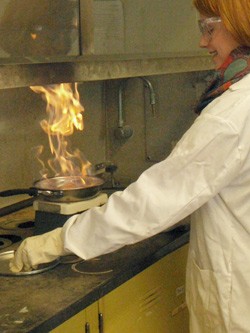
Christine Hansen ’12, who starts graduate school in the area of food science at Cornell this fall, conducted a two-year research project that suggests that flambé does not enhance flavor.
The cooking technique in which a dish with alcohol is set alight at the table may be dramatic, but does it enhance the flavor? It doesn't seem so, according to an undergraduate research project at Cornell. Viticulture and enology student Christine Hansen '12, who starts graduate school in the area of food science at Cornell this fall, set out to discover what actually happens to food when a spirit is added and ignited, as part of a two-year research project she started in her sophomore year. Inspired by a lecture about measuring ethanol in wine and spirits by Gavin Sacks, assistant professor of food science, Hansen first prepared a caramel sauce, similar to that used in bananas Foster, using flambé. As a control, she also prepared a sauce that was heated but not ignited, and a third sauce that was neither heated nor ignited. The sauces were then subjected to chemical and sensory analysis. "Surprisingly, the ethanol content of samples that were ignited - as in flambé - were nearly identical to those that have just been heated," said Hansen. "While there are small differences in the final ethanol concentration, almost all of the ethanol and water loss can be explained by evaporation and not the actual ignition." Hansen also investigated the claim of some cookbooks that browning reactions - important to the flavor of grilled meat and roasted coffee - may occur during flambé.
TO READ THIS ARTICLE, CREATE YOUR ACCOUNT
And extend your reading, free of charge and with no commitment.