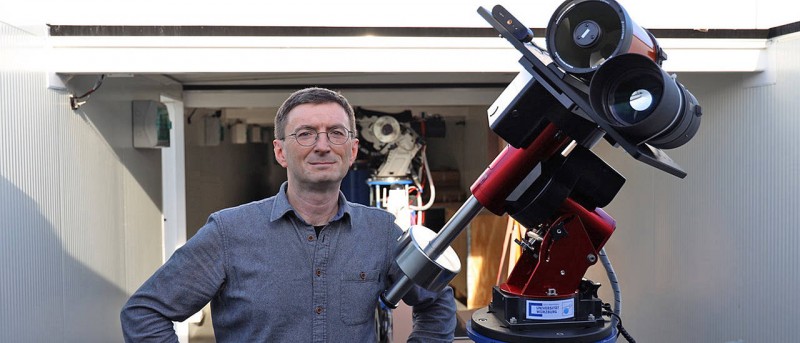
Hakan Kayal next to the moon telescope. (Image: Tobias Greiner / Universität Würzburg)
05/31/2019 - On the moon flashes and other enigmatic light phenomena can be observed again and again. With a new telescope, a professor at the University of Würzburg wants to get to the bottom of these phenomena. It happens several times a week. Sometimes it is only short flashes of light that appear on the surface of the moon. Other light phenomena on the Earth's satellite can last longer. And sometimes there are also places that darken temporarily. Science does not know exactly how these phenomena occur on the moon. But it has attempts to explain them: the impact of a meteor, for example, should cause a brief glow. Such flashes could also occur when electrically charged particles of the solar wind react with moon dust. "Seismic activities were also observed on the moon. When the surface moves, gases that reflect sunlight could escape from the interior of the moon. This would explain the luminous phenomena, some of which last for hours," says Hakan Kayal, Professor of Space Technology at Julius-Maximilians-Universität Würzburg (JMU) in Bavaria, Germany. Moon telescope set up in Spain Kayal is most interested in these appearances. "The so-called transient lunar phenomena have been known since the 1950s, but they have not been sufficiently systematically and long-term observed. This is currently changing, and the JMU professor wants to make his contribution. As a first step, Kayal's team built a lunar telescope and put it into operation in April 2019. It is located in a private observatory in Spain, about 100 kilometres north of Seville in a rural area. Why Spain?
TO READ THIS ARTICLE, CREATE YOUR ACCOUNT
And extend your reading, free of charge and with no commitment.