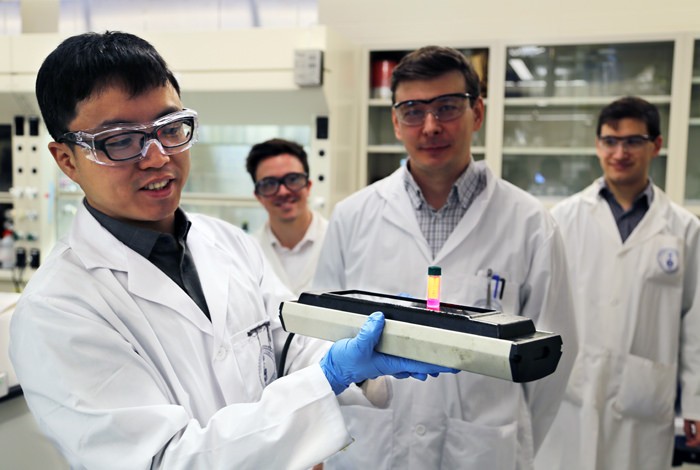
Scientists have developed a method for creating laser light using colloidal quantum dots. University of Toronto and Los Alamos National Laboratory developed the technology, with partners from Vanderbilt University and University of New Mexico.
Steady state lasing with colloidal quantum dots an important step toward practical lasing technology. 'This work brings us a step closer to the next important goal - the demonstration of lasing with electrical pumping, at which point colloidal quantum dot laser diodes will become a technological reality,' said Victor Klimov. Steady state lasing with colloidal quantum dots an important step toward practical lasing technology. LOS ALAMOS, N.M. March 20, 2017-A multi-institutional team of researchers from Canada and the US has demonstrated steady state lasing with solution-processed nanoparticles called "colloidal quantum dots,” an important step on the path to improving laser tools for fiber optics, video projectors and more accurate medical testing technology. "This work brings us a step closer to the next important goal - the demonstration of lasing with electrical pumping, at which point colloidal quantum dot laser diodes will become a technological reality,” said Victor Klimov, a Los Alamos National Laboratory participant in the present project and principal contributor to the original demonstration of the quantum dot lasing effect. The new studies prove the feasibility of steady state lasing with colloidal quantum dots and provide practical guidelines to make them even better as optical-gain media. Improving quantum dot lasing could produce better tools for detailed, cellular-level biochemical analysis, and take video projectors to a more efficient level than the current LCD versions.
TO READ THIS ARTICLE, CREATE YOUR ACCOUNT
And extend your reading, free of charge and with no commitment.