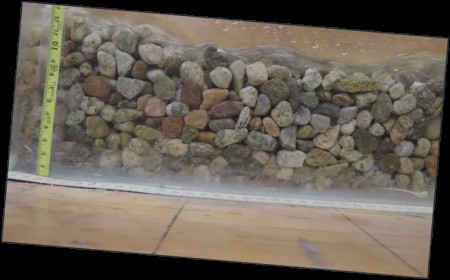
Artificial river in the Earth Surface Dynamics Lab at Caltech built to model the behavior of steep channels
In the Earth Surface Dynamics Lab at the California Institute of Technology (Caltech) the behavior of rivers is modeled through the use of artificial rivers-flumes-through which water can be pumped at varying rates over a variety of carefully graded sediments while drag force and acceleration are measured. The largest flume is a 12-meter tilting version that can model many river conditions; another flume models the languid process of a nearly flat river bed forming a delta as it reaches a pool. Additional flumes are constructed in the lab on an as-needed basis, as in a recent study testing sediment transport in very steep channels. One such newly constructed flume demonstrates that the slope of streambeds has dramatic and unexpected effects on sediment transport. Logic would suggest that steeper streambeds should allow for easy sediment transport since, as the angle of the slope increases, gravity should assist with moving water and sediment downstream. But experimental data from the flume lab show that gravity does not facilitate sediment transport in the expected manner. Furthermore, in very steep streambeds with a 22-degree or higher slope, sediment motion begins not with grains skipping and bouncing along the bottom of the streambed, but rather with a complete bed failure in which all the sediment is abruptly sent hurtling downstream as a debris flow.
TO READ THIS ARTICLE, CREATE YOUR ACCOUNT
And extend your reading, free of charge and with no commitment.