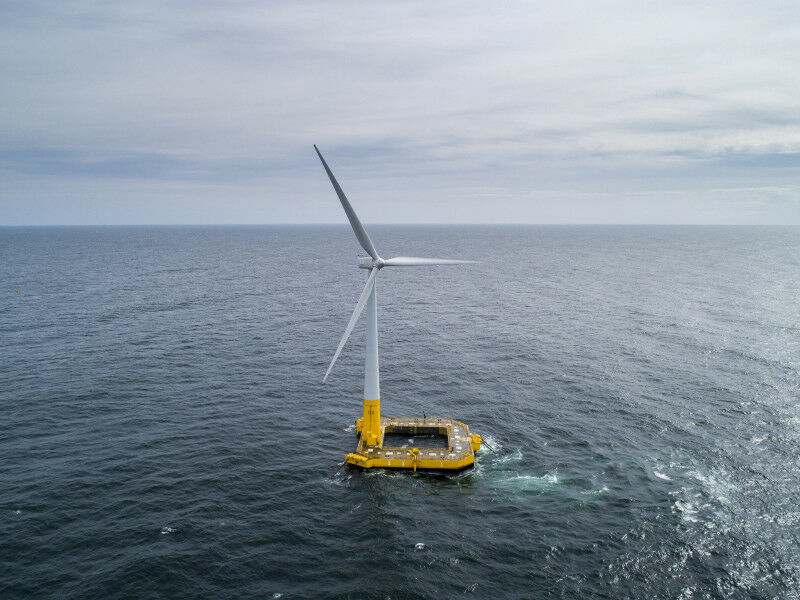
VAMOS/FLOATEOLE is launched to further reduce the cost of floating offshore wind [Picture: Ideol, V. Joncheray]
VAMOS/FLOATEOLE is launched to further reduce the cost of floating offshore wind [ Picture: Ideol, V. Joncheray] Offshore wind is taking the next step: floating foundations for deeper waters are becoming a tested and proven technology. How can we further reduce their cost to accelerate their deployment? - A good understanding of floating offshore wind turbines is essential to decrease the uncertainties and risks - and thus the costs - of this very promising technology. The project "Validation, Measurement and Optimization of Floating Wind Energy" (VAMOS) addresses this challenge with a large-scale measurement campaign and a validation study. The knowledge gained will be used directly for the design of an improved turbine controller to enhance the dynamic behavior and reduce loads. In the long term, this will allow for lighter weight and cheaper turbine designs. For the first time, a research project on floating wind energy is co-funded by the German Federal Ministry of Economics and Energy and the French Regional cluster West Atlantic Marine Energy Community. Seven partners are cooperating in the joint project VAMOS for 36 months: - Stuttgart Wind Energy (SWE) at the University of Stuttgart, the Research Laboratory in Hydrodynamics, Energetics and Atmospheric Environment at Centrale Nantes (ECN), the Institute for Fluid Dynamics and Ship Theory at Hamburg University of Technology (TUHH) and GL Garrad Hassan Deutschland GmbH, UL International GmbH and Ideol, as associated partners.
TO READ THIS ARTICLE, CREATE YOUR ACCOUNT
And extend your reading, free of charge and with no commitment.