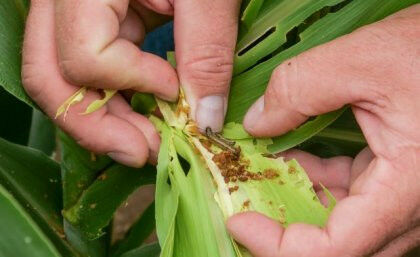
Fall armyworm in a trial crop. Image: Megan Pope
Fall armyworm in a trial crop. Image: Megan Pope The University of Queensland is working with the Queensland Department of Agriculture and Fisheries (DAF) develop guidelines to help Australian grain growers decide when and how to treat fall armyworm (FAW) to save their crops and finances. The highly invasive pest was detected in Australia three years ago and poses a major threat to broadacre crops including maize and sorghum. Dr Joe Eyre from UQ's Queensland Alliance for Agriculture and Food Innovation (QAAFI) is working with DAF on the project, which has investment from the Grains Research and Development Corporation (GRDC) and will determine economic thresholds for the pest to give farmers certainty. "The overseas recommendations for treating fall armyworm are vague, and we don't know how they relate to the Australian environment," Dr Eyre said. "The current recommendations are to take action based on obvious damage from the caterpillars, which may not be the most economically efficient or ecologically friendly time to protect crops." The research project will establish the relationship between the timing of an infestation, its density and the crop's response. "Fall armyworm are easy to treat when small so we need to predict what the likely yield loss is going to be if the infestation is not treated, as opposed to spending money on treatments when it is too late or when FAW are unlikely to result in yield penalty," Dr Eyre said.
TO READ THIS ARTICLE, CREATE YOUR ACCOUNT
And extend your reading, free of charge and with no commitment.