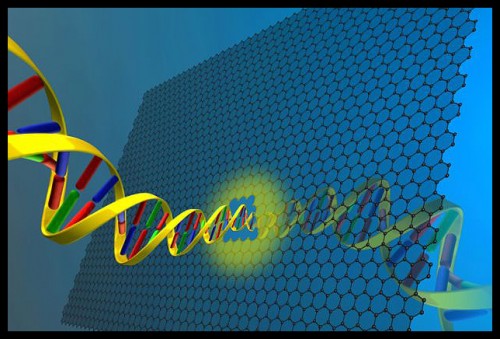
A layer of graphene is shown with a tiny nanopore drilled into its surface. Researchers at Harvard and MIT say the membrane holds potential for speeding up DNA sequencing due to its extreme thinness.
Researchers from Harvard University and MIT have demonstrated that graphene, a surprisingly robust planar sheet of carbon just one-atom thick, can act as an artificial membrane separating two liquid reservoirs. By drilling a tiny pore just a few-nanometers in diameter, called a nanopore, in the graphene membrane, the researchers were able to measure exchange of ions through the pore and demonstrate that a long DNA molecule can be pulled through the graphene nanopore just as a thread is pulled through the eye of a needle. ?By measuring the flow of ions passing through a nanopore drilled in graphene we have demonstrated that the thickness of graphene immersed in liquid is less then 1 nm thick, or many times thinner than the very thin membrane which separates a single animal or human cell from its surrounding environment," says lead author Slaven Garaj , a Physics Research Associate at Harvard. "This makes graphene the thinnest membrane able to separate two liquid compartments from each other. The thickness of the membrane was determined by its interaction with water molecules and ions.' Graphene, the strongest material known, has other advantages. Most importantly, it is electrically conductive. 'Although the membrane prevents ions and water from flowing through it, the graphene membrane can attract different ions and other chemicals to its two atomically close surfaces.
TO READ THIS ARTICLE, CREATE YOUR ACCOUNT
And extend your reading, free of charge and with no commitment.