 © EPFL
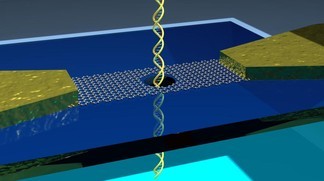
One of the methods used for examining the molecules in a liquid consists in passing the fluid through a nano-sized hole so as to detect their passage. EPFL researchers have found a way to improve this technique by using a material with unique properties: graphene. If we wanted to count the number of people in a crowd, we could make on the fly estimates, very likely to be imprecise, or we could ask each person to pass through a turnstile. The latter resembles the model that EPFL researchers have used for creating a "DNA reader" that is able to detect the passage of individual DNA molecules through a tiny hole: a nanopore with integrated graphene transistor. The DNA molecules are diluted in a solution containing ions and are driven by an electric field through a membrane with a nanopore. When the molecule goes through the orifice, it provokes a slight perturbation to the field, detectable not only by the modulations in ionic current but also by concomitant modulation in the graphene transistor current. Based on this information, it is possible to determine whether a DNA molecule has passed through the membrane or not.
TO READ THIS ARTICLE, CREATE YOUR ACCOUNT
And extend your reading, free of charge and with no commitment.
Your Benefits
- Access to all content
- Receive newsmails for news and jobs
- Post ads