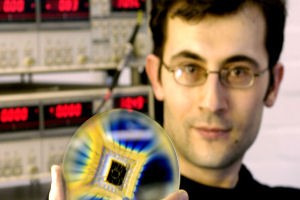
Dr Ponomarenko with grphene chips
10 Oct 2011 - Scientists at the University of Manchester have come one step closer to creating the next generation of computer chips using wonder material graphene. The world's thinnest, strongest and most conductive material, discovered in 2004 at the University of Manchester by Professor Andre Geim and Professor Kostya Novoselov, has the potential to revolutionize material science. Demonstrating the remarkable properties of graphene won the two scientists the Nobel Prize for Physics last year and Chancellor of the Exchequer George Osborne has just announced plans for a £50m graphene research hub to be set up. Now, writing , the University of Manchester team have for the first time demonstrated how graphene inside electronic circuits will probably look like in the future. By sandwiching two sheets of graphene with another two-dimensional material, boron nitrate, the team created the graphene 'Big Mac' - a four-layered structure which could be the key to replacing the silicon chip in computers. Because there are two layers of graphene completed surrounded by the boron nitrate, this has allowed the researchers for the first time to observe how graphene behaves when unaffected by the environment. Leonid Ponomarenko, the leading author on the paper, said: "Creating the multilayer structure has allowed us to isolate graphene from negative influence of the environment and control graphene's electronic properties in a way it was impossible before.
TO READ THIS ARTICLE, CREATE YOUR ACCOUNT
And extend your reading, free of charge and with no commitment.