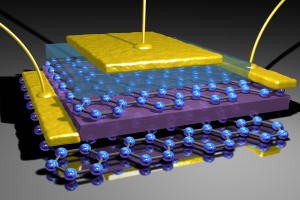
Graphene transistors could be key in medical imaging and security devices
30 Apr 2013 A new transistor capable of revolutionising technologies for medical imaging and security screening has been developed by graphene researchers from the Universities of Manchester and Nottingham. Writing in Nature , the researchers report the first graphene-based transistor with bistable characteristics, which means that the device can spontaneously switch between two electronic states. Such devices are in great demand as emitters of electromagnetic waves in the high-frequency range between radar and infra-red, relevant for applications such as security systems and medical imaging. Bistability is a common phenomenon - a seesaw-like system has two equivalent states and small perturbations can trigger spontaneous switching between them. The way in which charge-carrying electrons in graphene transistors move makes this switching incredibly fast - trillions of switches per second. Wonder material graphene is the world's thinnest, strongest and most conductive material, and has the potential to revolutionise a huge number of diverse applications; from smartphones and ultrafast broadband to drug delivery and computer chips. It was first isolated at The University of Manchester in 2004.
TO READ THIS ARTICLE, CREATE YOUR ACCOUNT
And extend your reading, free of charge and with no commitment.