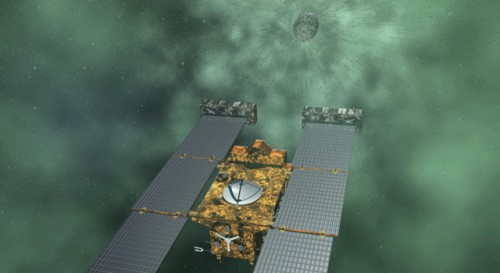
Artist’s concept of NASA’s Stardust-NExT mission, which will fly by comet Tempel 1 on Feb. 14, 2011. Image credit: NASA/JPL-Caltech/LMSS
A bonus round is something one usually associates with the likes of a TV game show, not a pioneering deep space mission. "We are definitely in the bonus round," said Stardust-NExT Project Manager Tim Larson of NASA's Jet Propulsion Laboratory in Pasadena, Calif. "This spacecraft has already flown by an asteroid and a comet, returned comet dust samples to Earth, and now has almost doubled its originally planned mission life. Now it is poised to perform one more comet flyby." A Successful Prime Mission NASA's Stardust spacecraft was launched on Feb. 7, 1999, on a mission that would explore a comet as no previous mission had. Before Stardust, seven spacecraft from NASA, Russia, Japan and the European Space Agency had visited comets - they had flight profiles that allowed them to perform brief encounters, collecting data and sometimes images of the nuclei during the flyby. Like those comet hunters before it, Stardust was tasked to pass closely by a comet, collecting data and snapping images.
TO READ THIS ARTICLE, CREATE YOUR ACCOUNT
And extend your reading, free of charge and with no commitment.