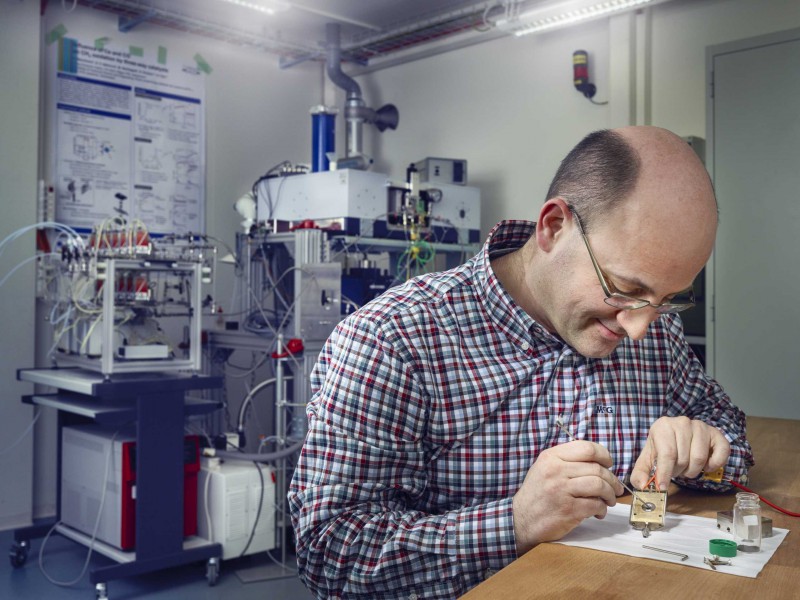
Davide Ferri prepares a catalyst sample in the measurement chamber. Afterwards the chamber will be mounted in the instrument visible in the background or moved to a beamline and probed there with synchrotron light. (Photo: Scanderbeg Sauer Photography)
An ingenious measurement chamber. Natural-gas vehicles are on the way, and they need catalytic converters for the exhaust too. So far, catalytic converters for gasoline-powered vehicles have been modified to fill this gap; however, these are not geared towards removing the climate-harmful methane that the exhaust from natural-gas vehicles contains. While work is under way at Empa, the Swiss Federal Laboratories for Materials Testing and Research, to optimise natural-gas engines and catalytic converters, the PSI is specialising in the development of research methods that enable very precise observation of processes in catalytic converters. For different methods, different types of radiation are used, which yield different insights into the catalytic converters. Until now it was necessary to set up the catalytic converter to be studied in a new measurement chamber for each of these methods. Now researchers at the PSI have developed a universal measurement chamber in which catalytic converters can be studied with a variety of different methods, yet always under the same conditions.
TO READ THIS ARTICLE, CREATE YOUR ACCOUNT
And extend your reading, free of charge and with no commitment.