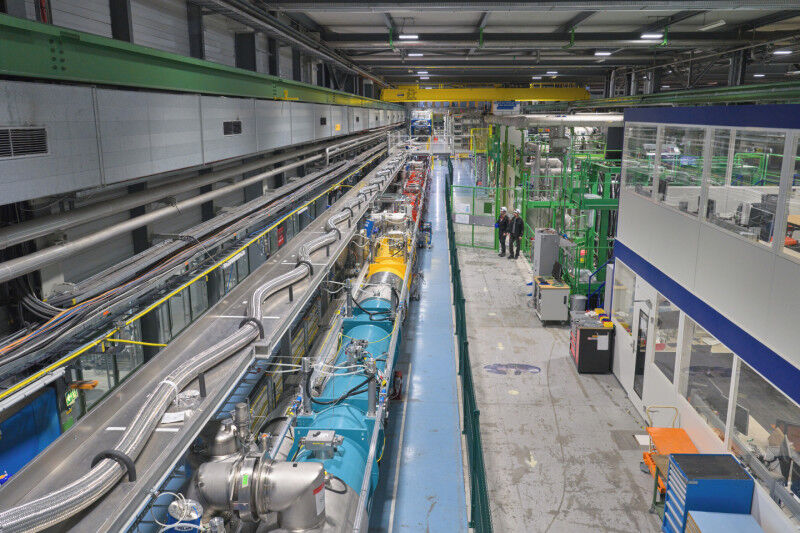
CERN has taken a decisive step towards the High-Luminosity Large Hadron Collider (HiLumi LHC) with the start of the cryogenic cooldown of its full-scale test facility to 1.9 kelvin (-271.3 °C). The 95-metre-long test stand replicates the advanced equipment that will progressively transform the LHC over the coming years and is designed to validate the new generation of beam-focusing magnets and their highly complex infrastructure. These systems form a cornerstone of the LHC upgrade scheduled to come into operation in 2030.
Long Shutdown 3 marks the transition to HiLumi LHC
This summer will mark the beginning of Long Shutdown 3 (LS3), a four-year period of intensive work during which the LHC will be converted into the HiLumi LHC. The upgraded accelerator will deliver a tenfold increase in collision rates, or luminosity, dramatically expanding the amount of data available to physicists. This gain in performance will allow unprecedented precision in the study of the Higgs boson and other fundamental particles, while opening the door to the observation of rare and potentially revolutionary phenomena.
Exploring the unknown with unprecedented precision
’The importance and excitement of the High-Luminosity LHC cannot be overstated,’ says CERN Director-General Mark Thomson. ’It is the largest project undertaken by CERN in the past 20 years. Together with upgraded detectors and advanced data analysis tools, it will enable us, for the first time, to study how the Higgs boson interacts with itself, a measurement that could shed light on the earliest moments of the Universe and its possible future. The HiLumi LHC will also explore completely uncharted territory, where the unexpected may well emerge.’
New technologies at the heart of the upgrade
The HiLumi LHC relies on a suite of cutting-edge technologies never before deployed in a proton accelerator. These include superconducting crab cavities that tilt particle beams to maximise collision rates, crystal collimators that remove stray particles with high precision, and high-temperature superconducting power lines designed for efficient magnet operation.
At the heart of the upgrade are the new inner triplet magnets, made from a niobium-tin (Nb3Sn) superconducting compound capable of generating stronger magnetic fields than the niobium-titanium magnets used in the current LHC. Installed on either side of the ATLAS and CMS experiments, these magnets will operate at 1.9 kelvin, the same ultra-low temperature as the existing LHC magnet system.
Validating integration before underground installation
To ensure that all components work together seamlessly, CERN has constructed an above-ground, full-scale replica of the underground layout known as the Inner Triplet String. This facility allows engineers and physicists to test the integration and collective performance of the new systems under realistic operating conditions.
’While each system has already been tested individually, the Inner Triplet String allows us to validate their combined operation,’ explains Oliver Bruning, CERN Director for Accelerators and Technology. ’It gives us the opportunity to optimise procedures and gain operational experience before installation in the tunnel, ensuring a smooth and efficient deployment.’
Global collaboration for the next era of particle physics
In parallel, the ATLAS and CMS experiments are undergoing extensive upgrades to fully exploit the scientific potential of the HiLumi LHC. This work is being carried out in close collaboration with hundreds of institutes worldwide. Improvements across the entire accelerator complex will further reinforce CERN’s leading role in high-energy physics.
Led by CERN, the HiLumi LHC project brings together nearly 50 institutes from more than 20 countries, predominantly in Europe. In addition to funding from CERN Member and Associate Member States, the project has received special contributions from several European countries as well as from international partners including the United States, Japan, Canada and China.
A critical phase underway
The cooldown of the HiLumi LHC test string, achieved using a sophisticated liquid-helium refrigeration and distribution system, is expected to take several weeks to complete. This phase represents a crucial milestone in preparing the next leap forward for high-energy physics.