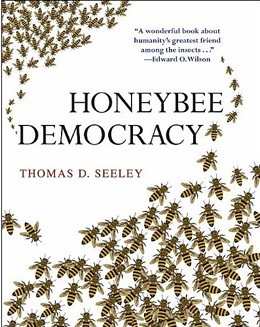
Thomas Seeley’s new book, "Honeybee Democracy" was recently published by Princeton University Press.
When honeybees seek a new home, they choose the best site through a democratic process that humans might do well to emulate, says a Cornell biologist in his new book, "Honeybee Democracy" (Princeton University Press). Part memoir and part story of scientific discovery, the book by Thomas Seeley, professor of neurobiology and behavior, describes the elaborate decision-making process that honeybees (Apis mellifera) use when they make the life or death choice of a nesting cavity. The book explains how in early summer, when a hive becomes overpopulated, some two-thirds of the worker bees and the old queen leave home in a swarm and gather on a nearby branch. Over the next few days, several hundred scout bees, which are the oldest bees, search out 10 to 20 potential home sites in hollow trees. Back at the swarm, each site gets announced with a waggle dance, indicating the site's location and advertising the find to other scouts. "A scout adjusts how long she dances according to the goodness of the site," said Seeley. "She has a built-in ability to judge site quality (based on cavity volume, entrance size and such), and she is honest; if the site is mediocre she won't advertise it strongly." In turn, other scouts inspect the sites and return to dance themselves.
TO READ THIS ARTICLE, CREATE YOUR ACCOUNT
And extend your reading, free of charge and with no commitment.