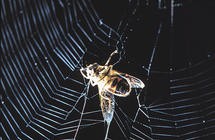
A fly caught in an electrostatic web (Image: Fritz Vollrath)
Spider webs actively spring towards prey thanks to electrically conductive glue spread across their surface, Oxford University scientists have discovered. The researchers found that the electrostatic properties of the glue that coats spider webs causes them to reach out to grab all charged particles, from pollen and pollutants to flying insects. They also showed that the glue spirals can distort the Earth's electric field within a few millimetres of the web, which may enable insects to spot the webs with their antennae 'e-sensors'. The study, published in Naturwissenschaften , shows how a quirk of physics causes webs to move towards all airborne objects, regardless of whether they are positively or negatively charged. This explains how webs are able to collect small airborne particles so efficiently and why they spring towards insects. According to the researchers, common garden spider webs around the world could be used for environmental monitoring as they actively filter airborne pollutants with an efficiency comparable to expensive industrial sensors. 'The elegant physics of these webs make them perfect active filters of airborne pollutants including aerosols and pesticides,' said Professor Fritz Vollrath of Oxford University's Department of Zoology, who led the study.
TO READ THIS ARTICLE, CREATE YOUR ACCOUNT
And extend your reading, free of charge and with no commitment.