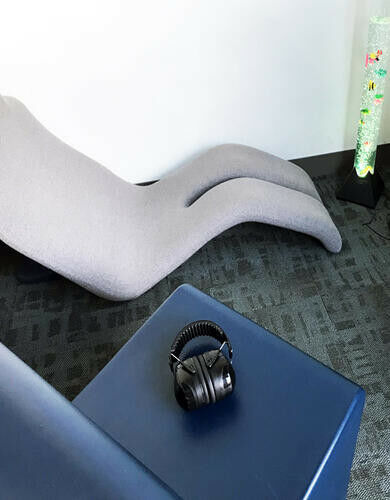
UCalgary provides sensory-friendly spaces for neurodiverse students, including a room in the Taylor Family Digital Library Werklund School of Education
UCalgary provides sensory-friendly spaces for neurodiverse students, including a room in the Taylor Family Digital Library Werklund School of Education An increasing number of neurodiverse students, including those on the autism spectrum, are attending post-secondary education worldwide. Despite the demographic shift, supports for this community remain inadequate and graduation rates for autistic students have stalled at approximately 30 per cent. Dr. Carly McMorris , PhD, and Jennifer Williamson are leading a new research project that addresses this imbalance by exploring the mental health experiences of autistic university students. "Many higher-education students struggle with mental health, but neurodivergent students are extra vulnerable since they experience elevated rates of mental-health issues relative to the general population," says McMorris, an associate professor in the Werklund School of Education and founder of The Enhance Lab. "Approximately 40 to 70 per cent of individuals with ASD experience a mental-health issue, which makes it essential that we hear directly from the students." Impediments to learning. According to McMorris and Williamson, the challenges that impact the mental health and academic success of autistic students are myriad. Sensory overload is a common difficulty, with study spaces and classrooms being too loud or brightly lit.
TO READ THIS ARTICLE, CREATE YOUR ACCOUNT
And extend your reading, free of charge and with no commitment.