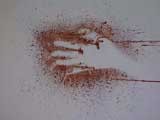
A reconstructed hand stencil
Ice Age ancestors were handy artists. Researchers at the University of Sheffield have been exploring how our Ice Age ancestors used intricate hand stencils to decorate their cave dwellings over 20,000 years ago. Paul Pettitt and Rebecca Harrison reconstruct Ice Age cave art Paul Pettitt from the University's Department of Archaeology and Rebecca Harrison, Leverhulme Research Assistant, painstakingly reconstructed the ancient art form, now on display at the Royal Society in London as part of Many Hands , an exhibition exploring the deep history of hands in art. The team experimented with different techniques to produce the art of our ancestors. Pettitt said: "We have known for a long time that these paintings were produced by spraying watered down ochre (a natural pigment), but what we don´t know is the technique they used to achieve the final result. Our technique, in which we use a shell to hold the dye and blow it across our hands through hollowed out bones or reeds, gives the best result." The Ice Age art has been found in hard to reach places within the cave dwellings, in countries such as Spain (Malaga, Asturias and Cantabria) and France (Pech Merle in Lot). Pettitt has worked in these sites and is also set to explore hand stencils in the spectacular caves of La Garma and El Castillo in Spain.
TO READ THIS ARTICLE, CREATE YOUR ACCOUNT
And extend your reading, free of charge and with no commitment.