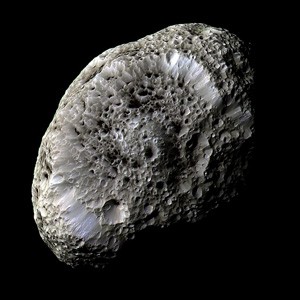
Saturn’s icy moon
Hyperion, famous for its deeply cratered surface, which gives the body a sponge-like appearance. Hyperion’s orbit and rotation are perturbed by the much more massive Titan. Credit:
"NASA/JPL/Space Science Institute"
The mysterious Ice Worlds of the outer solar system are being brought to life this week at the Royal Society Summer Science Exhibition. Watch video At huge distances from the Sun, the moons of the outer planets and dwarf planets, such as Pluto, reside in a bizarre world of extreme cold where water behaves like a solid rock. However, despite the biting cold, many of these worlds are alive with activity, such as the erupting geysers on the surface of Neptune's moon Triton. Visitors to the exhibit will be able to experience reconstructions of the often rugged icy surfaces of these worlds, which lie hundreds of millions of miles away from our own planet. Scientists from UCL, the University of Kent, Queen's University Belfast, and Imperial College London, will be on hand to explain the spectacular images, scale models and 3D images that have been captured during their research into the edges of our solar system. Lead exhibitor Dr Geraint Jones, from UCL's Mullard Space Science Laboratory, said: "We hope to demonstrate to the public how exciting these ice worlds are. They have everything: towering cliffs of ice, active geysers, complex atmospheres, and hidden oceans of water." He added: "A few icy moons even have oceans of water hidden beneath their outer crust.
TO READ THIS ARTICLE, CREATE YOUR ACCOUNT
And extend your reading, free of charge and with no commitment.