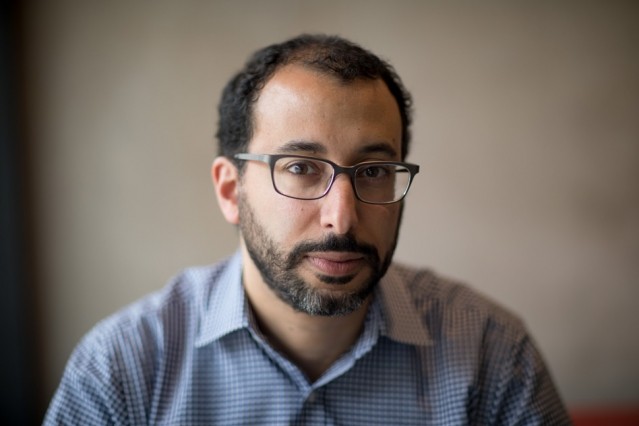
‘I’m driven by developing methodology that will be broadly useful,’ says Youssef Marzouk, associate of aeronautics and astronautics at MIT.
How does today's weather compare with what was forecast a week or even a day ago? Is that torrential Nor'easter that was predicted in fact just a light drizzle' Has the sun, projected to emerge from the clouds at 11 a.m., instead appeared at noon? It may come as no surprise that weather predictions come with a fair amount of uncertainty, as do any predictions of large, complex, and interacting systems. And yet, many of us depend on such simulations for information, from everyday traffic and weather reports, to long-term projections for climate. 'You're sort of using a simulation as an oracle,' says Youssef Marzouk, associate professor of aeronautics and astronautics at MIT. 'But if we're really going to use computations as a way of predicting what's happening in the world, how can we get a handle on this very fuzzy problem of how believable the computations are'' Quantifying and reducing the uncertainty in complex computational models is the major theme in Marzouk's work, which he is applying to a wide range of problems, including tracking underground contaminants, characterizing combustion in jet engines, estimating the concentrations of trace gases in the atmosphere, and improving the accuracy in weather forecasts. 'I'm driven by developing methodology that will be broadly useful,' says Marzouk, who earned tenure in 2016. An abstract pull In the 1970s, Marzouk's parents emigrated from Egypt to the U.S., ultimately settling in St. Louis, Missouri, where his father took up a faculty position at Washington University's School of Dental Medicine.
TO READ THIS ARTICLE, CREATE YOUR ACCOUNT
And extend your reading, free of charge and with no commitment.