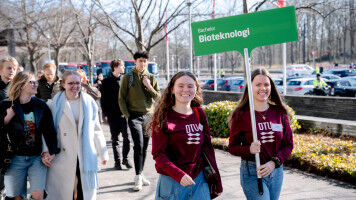
How can waste separation in a dormitory be improved - and what role can students from engineering and communication science play in that process? These questions form the basis of a teaching project at TU Ilmenau, which is part of the Klima-N research initiative that is funded by the BFTR. Under the title "Engineering Meets Communication Science", students and lecturers from different disciplines worked together to develop practical solutions for enhancing sustainability on campus.
Universities as drivers of change
Universities are not only places of learning but also real-world laboratories for societal transformation. As institutions where future decision-makers are educated, they have a unique responsibility. At TU Ilmenau, the project team takes this role seriously: using an interdisciplinary teaching format focused on waste separation and prevention, the university is turning Education for Sustainable Development (ESD) into hands-on practice.The idea for the project was inspired by collaboration with the University of Erfurt, which has long-standing experience integrating ESD into teaching. These practices have since been systematically evaluated within the Klima-N framework. The teaching project try to implement a ESD in higher education context by considering four core elements in teaching: (1) Addressing real and relevant societal problems, (2) integrating multiple worldviews and perspectives, (3) promoting communication and active participation among students, and (4) strengthening students’ sense of agency and ability to make team-based decisions.
This teaching project brings together the Group of Empirical Media Research and Political Communication from the Faculty of Economic Sciences and Media, and the Group of Product and System Development from the Faculty of Mechanical Engineering. A distinctive feature of the initiative is the integration of two existing courses: the application-oriented module "Communication for a Better Future" in the English-taught Master’s program Media and Communication Science , and the module "Product Development Methodology" in the German-taught Bachelor’s programs in Mechanical Engineering, Automotive Engineering, Mechatronics, and Mechanical Engineering.
The project began with communication science students conducting a stakeholder analysis to identify the needs of dormitory residents and the practical conditions required for effective waste separation. This analysis not only formed the basis for a targeted communication strategy, but also provided valuable insights for the engineering students. Using the findings, they developed an initial concept for a machine capable of automatically identifying types of waste.
Meanwhile, the communication students designed and implemented a strategy to inform and engage residents in sustainable waste practices. Their goal was not just to convey information but to encourage residents to separate waste properly their everyday lives. To achieve this, they had to learn and understand both the waste separation system and the behavioral habits of individuals.
said Abdur Rab Khan, a Master’s student in Media and Communication Science who participated in the course.
Often, environmental seminars can become quite abstract, but this one brought the topic down to earth-right into people’s kitchens, trash bins, and everyday routines,
Jens Wolling from the the Group of Empirical Media Research and Political Communication was particularly impressed by the students’ commitment:
It wasn’t easy to conceptualize and implement a real communication strategy in a real-world setting within a single semester. The students not only applied theory-they had to manage their time, collaborate effectively, and reconcile differing ideas to achieve their objectives.
Project Timeline and Outlook
The interdisciplinary teaching concept was developed during the winter term of 2024/25 and was first implemented and evaluated in the summer term of 2025. The insights and experiences gained are now feeding back into the teaching practices of the participating degree programs and are expected to inspire further interdisciplinary collaborations.Stephan Husung from the Group of Product and System Development from the Faculty of Mechanical Engineering sees great value in the initiative:
Interdisciplinary collaboration is the right way to achieve greater sustainability on campus and motivate students in real-world laboratories. I hope that we will have further opportunities in the future to conduct such teaching projects that address real-world problems. We must equip students with the skills to solve current and future challenges-projects like this are a step in the right direction.