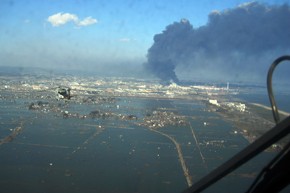
A US helicopter flies over the city of Sendai to deliver more than 1,500 pounds of food to survivors of an 8.9 magnitude earthquake and a tsunami. (U.S. Navy photo/Released)
Japan needs to urgently announce an overall strategy if it is to successfully respond to the nation's unfolding natural disaster, according to an expert from The Australian National University. Dr Peter McCawley, a visiting fellow in the ANU Crawford School of Economics and Government, warned that unless an overall strategy is announced soon, a coordinated and effective response to the disaster will become less likely. 'Of course all eyes in Japan, as well as the international community, are currently focused on the immediate issues,' said Dr McCawley. 'There is much concern about the dangers arising from the damage to the nuclear electricity plants in Fukushima, and the humanitarian needs of the survivors are very urgent. 'But unless an overall strategy is announced quite soon, problems of coordination can be expected to become more difficult very soon.' Dr McCawley, who has been researching the recovery process after the 2004 Asian tsunami, added that past experiences elsewhere showed that responses to mega-disasters need to be delivered in stages. 'It is often a useful strategy to have five main stages,' said Dr McCawley. 'These include the immediate response, the early relief stage, later rehabilitation, large-scale reconstruction and the return-to-normal stage.
TO READ THIS ARTICLE, CREATE YOUR ACCOUNT
And extend your reading, free of charge and with no commitment.