
91% of young people use social networks daily or several times a week. In the JAMESfocus 2025 report, social networks are platforms that enable both personal and public communication. Specifically, these are Instagram, TikTok, BeReal, Pinterest, X/Twitter, Reddit, Facebook and Tinder. The current study investigated which motives are relevant for young people when using social networks. The results show that Swiss young people primarily use social networks for entertainment (57%) and to search for information (46%) - self-expression, on the other hand, is only relevant for 4% of respondents. The results are based on the responses of over 1000 young people between the ages of 12 and 19 from all three language regions of Switzerland.
"The results contradict the common assumption that young people mainly use social networks to present themselves. It is quite possible that prevention measures are already having an impact and are leading to more conscious use," explains Svenja Deda-Bröchin, ZHAW researcher and co-author.
The platforms meet different needs
The strong emphasis on the entertainment motive can be linked to the popularity and frequency of use of the platforms. Instagram and TikTok are by far the most popular social networks among young people and are mainly used for entertainment purposes and to pass the time.The information motive, which is also very pronounced, shows how important it is for young people to obtain information via these platforms and the central importance of social media in this respect. When it comes to information, BeReal, Instagram, Pinterest and X/Twitter play a particularly important role. Despite the low level, the motive of self-presentation shows connections with the platforms Tinder, Facebook and BeReal. BeReal stands out as the only platform that serves all three motives equally, but is only used regularly by around a third of young people.
While girls use social networks significantly more often for entertainment purposes (63% vs. 50% for boys), there are also regional differences. Young people in French-speaking Switzerland use the platforms both for entertainment (66%) and to search for information (62%) more frequently than their peers in German-speaking Switzerland (53% and 38% respectively) or Ticino (52% and 53% respectively).
Cyberbullying: important findings for prevention work
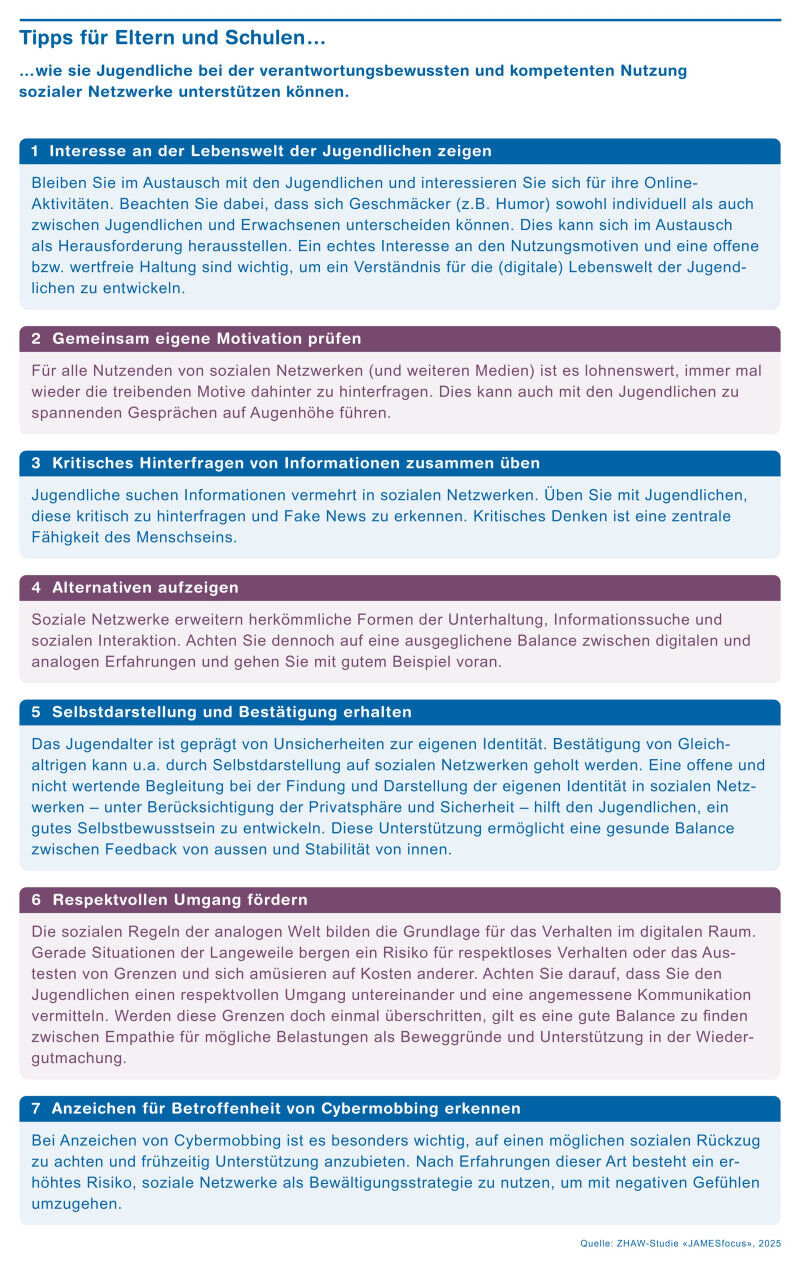
For the first time, a connection between usage motives and cyberbullying was also investigated. This showed that it makes a difference whether young people are looking for information on social networks, want to entertain themselves or want to present themselves. Young people who use social networks primarily for entertainment or self-presentation are more frequently affected by cyberbullying (passive cyberbullying) as well as being bullied themselves (active cyberbullying). This could be due to the fact that these young people spend more time online or offer a larger target for attack due to their intention to portray themselves. Another explanation could be that those affected by cyberbullying deliberately take refuge in social networks to distract themselves and that the high entertainment motive is an expression of this attempt at distraction.Social networks play a major role in the lives of young people. This makes it all the more important for parents and schools to show an interest in their children’s lives, to stay in touch with young people and to take an interest in their online activities without prejudice. Genuine interest in the motives for use and an open, non-judgmental attitude are important in order to develop an understanding of the (digital) world in which young people live. It is also advisable for parents to self-critically examine their own motives for use, as they are ultimately also role models for their children here.
Michael In Albon, Youth Media Protection Officer at Swisscom: ’The numerous preventative offers for families and schools on critical media use are triggering something: Time and again, the risks of digital media seem to be addressed at the kitchen table alongside the opportunities it offers. This is important and must be further promoted.
National study on youth media use: JAMES study and JAMESfocus report
The JAMES study maps the media use of young people in Switzerland. JAMES stands for ’Youth, Activities, Media Survey Switzerland’ and is conducted every two years. In this representative study, the ZHAW Zurich University of Applied Sciences has been interviewing over 1,000 young people aged 12 to 19 in the three major language regions of Switzerland about their media and leisure behavior on behalf of Swisscom since 2010.The JAMESfocus series uses the data from the JAMES study and analyzes other aspects in greater depth. The data collection for these results took place between April and June 2024.
In addition to this report, another thematic dossier on young people’s media use in connection with their body image will be published this year. A report on the use of AI by young people was already published in May.
Department of Applied Psychology at the ZHAW
The ZHAW Department of Applied Psychology is the leading competence center for scientifically based applied psychology in Switzerland. It consists of the Institute of Psychology and the IAP Institute of Applied Psychology. The Bachelor’s and Master’s degree programs, the Research & Development department and the consulting and continuing education programs make scientifically sound knowledge available to people and companies in their living and working environments.zhaw.ch/psychology