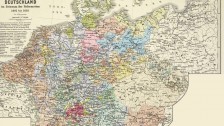
Detail of a map of the Holy Roman Empire, 1492 - 1618. Credit: Jo Whaley
Europe is in crisis and its future is said to depend on Germany. The most comprehensive study of Germany's early modern history ever undertaken, published this week, questions just how much we know about its past - and how much we understand it as a result. Understanding the history of the Reich cannot help us to construct a blueprint for Europe's future, but it can help us understand how Germany and Europe have become what they are today." - —Joachim Whaley - An epic new history of the final 300 years of Germany's first Reich reveals how the period gave birth to modern German identity and principles that still underpin its attempts to lead Europe today. A decade in the making, Germany and the Holy Roman Empire (1493-1806) , by the University of Cambridge historian Joachim Whaley, is the most comprehensive survey of Germany's early modern history ever undertaken, the first book of its kind since the 1950s, and one of the most substantial works of historical scholarship published in the UK this year. The two-volume study tells the story of more than 300 principalities and about 1,500 other minor territories. Together, these made up the later Holy Roman Empire, which covered much of northern and central Europe and constituted Germany's original Reich. Whaley believes that their story challenges much of what we think we know about Germany and its people today.
TO READ THIS ARTICLE, CREATE YOUR ACCOUNT
And extend your reading, free of charge and with no commitment.