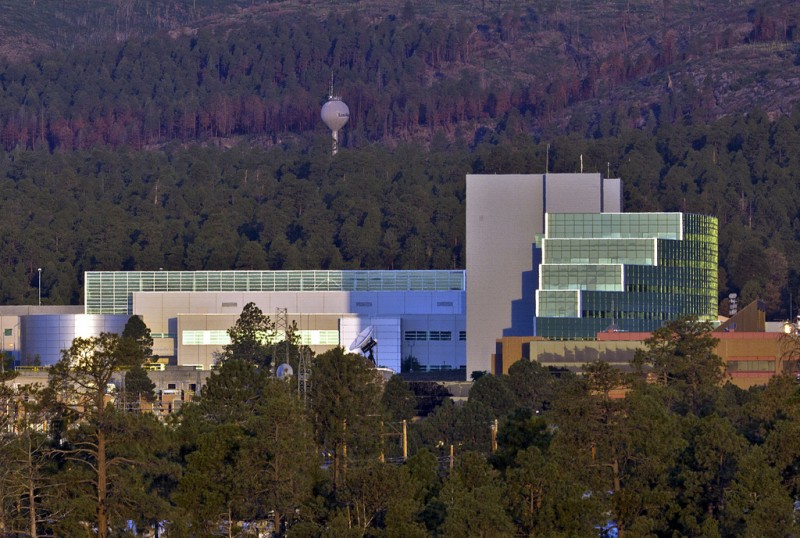
Los Alamos National Laboratory sits on top of a once-remote mesa in northern New Mexico with the Jemez mountains as a backdrop to research and innovation covering multi-disciplines from bioscience, sustainable energy sources, to plasma physics and new materials.
LOS ALAMOS, New Mexico, March 9, 2009—Los Alamos National Laboratory announced today that Lab demolition projects under the American Recovery and Reinvestment Act have recovered more than 136 tons of recyclable metal since work began last year, largely due to the skill of heavy equipment operators and efforts to gut the buildings before they come down. Some 106 tons of metal came from one large building alone, 16 tons more than the original estimate. "Recycling metal from a demolition project reduces costs and cuts the amount of waste that goes to a landfill," said Al Chaloupka, LANL's demolition program director. "We put a lot of effort into getting metal separated from the debris and making sure it isn't contaminated so it can be recycled." "Minimizing waste is an important part of our cleanup responsibilities," said George Rael, Environmental Projects manager for the Los Alamos Site Office of the National Nuclear Security Administration. "It's just as important as safely getting the waste to licensed disposal facilities." Los Alamos will demolish 21 Cold War-era buildings using Recovery Act funds provided through DOE's Office of Environmental Management in July 2009. Nine uncontaminated buildings have been demolished since then. All are located in the Lab's historic Technical Area 21, which supported plutonium production in the 1950s and 1960s as well as important nonweapons research.
TO READ THIS ARTICLE, CREATE YOUR ACCOUNT
And extend your reading, free of charge and with no commitment.