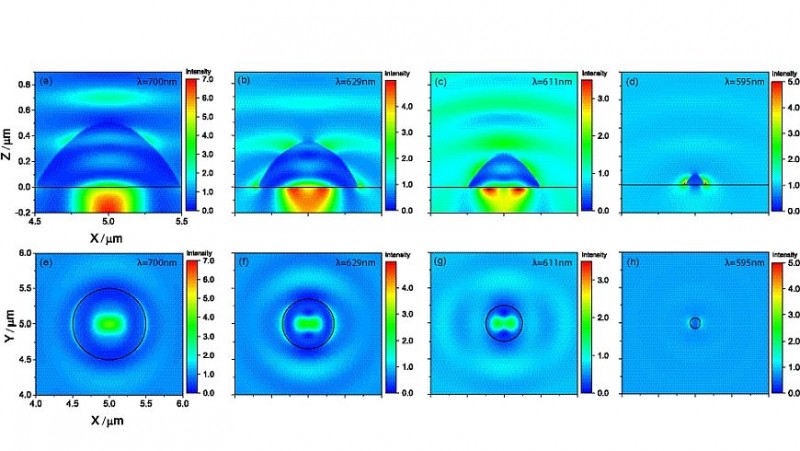
Cross sections (top row) and top view (bottom row) of the simulated near-field intensity within cyanine dye droplets of 500, 350, 250 and 70 nm on a glass substrate. Copyright: Advanced Optical Materials / Wiley
Researchers are on the lookout for rapid, reliable and affordable switches for the opto-electronics of the future. The solution: dye droplets measuring just a few sub-micrometers in diameter. Scientists from Empa's Laboratory for Functional Polymers are on the lookout for liquids that spread as evenly as possible on a surface for the production of OLEDs. However, the very same lab is also working on precisely the opposite: a liquid that is supposed to break up into as many droplets as possible when applied to a surface. Each of these droplets forms a microlens when it dries. A whole field of these microlenses can influence beams of light in a specific way, which makes them extremely interesting for optic signal processing in computers and fiber optic networks. "We take advantage of the fact that the droplets organize themselves," says Jakob Heier, who is studying the optic properties of these microlenses.
TO READ THIS ARTICLE, CREATE YOUR ACCOUNT
And extend your reading, free of charge and with no commitment.