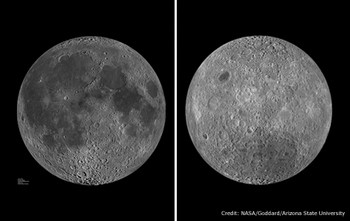
The moon’s near side (left) is covered with dark splotches of lunar maria that look like a man’s face when seen from Earth. The moon’s far side (right), with its many craters and elevated topography, looks quite different.
Many of us see a man in the moon—a human face smiling down at us from the lunar surface. The "face," of course, is just an illusion, shaped by the dark splotches of lunar maria (smooth plains formed from the lava of ancient volcanic eruptions). Like a loyal friend, the man is always there, constantly gazing at us as the moon revolves around Earth, locked in what's called a synchronous orbit, in which the moon rotates exactly once every time it orbits Earth. But why did the moon settle into an orbit with the man—rather than the moon's crater-covered far side—facing Earth? Previously, some scientists have thought the fact that we see the man is just the result of a coincidence, a sort of lunar coin toss, says Oded Aharonson, professor of planetary science at the California Institute of Technology (Caltech). But he and his colleagues have now found that is not the case. In the past, the moon spun around its axis faster than it does today, and their new analysis shows that the fact that the man now faces us may be a result of the rate at which the moon slowed down before becoming locked into its current orientation. Aharonson, along with Peter Goldreich, the Lee DuBridge Professor of Astrophysics and Planetary Physics, Emeritus, and Re'em Sari of the Hebrew University of Jerusalem, describe their findings in a paper published online on February 27 in the journal Icarus.
TO READ THIS ARTICLE, CREATE YOUR ACCOUNT
And extend your reading, free of charge and with no commitment.