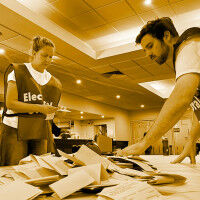
Making each vote count
MIT PhD candidate Jacob Jaffe uses data science to identify and solve problems in election administration. Graduate student Jacob Jaffe wants to improve the administration of American elections. To do that, he is posing "questions in political science that we haven't been asking enough," he says, "and solving them with methods we haven't been using enough." Considerable research has been devoted to understanding "who votes, and what makes people vote or not vote," says Jaffe. He is training his attention on questions of a different nature: Does providing practical information to voters about how to cast their ballots change how they will vote? Is it possible to increase the accuracy of vote-counting, on a state-by-state and even precinct-by-precinct basis? How do voters experience polling places? These problems form the core of his dissertation. Taking advantage of the resources at the MIT Election Data and Science Lab, where he serves as a researcher, Jaffe conducts novel field experiments to gather highly detailed information on local, state, and federal elections, and analyzes this trove with advanced statistical techniques. Whether investigating the probability of miscounts in voting, or the possibility of changing a voter's mode of voting, Jaffe intends to strengthen the scaffolding that supports representative government. "Elections are both theoretically and normatively important; they're the basis of our belief in the moral rightness of the state to do the things the state does," he says.