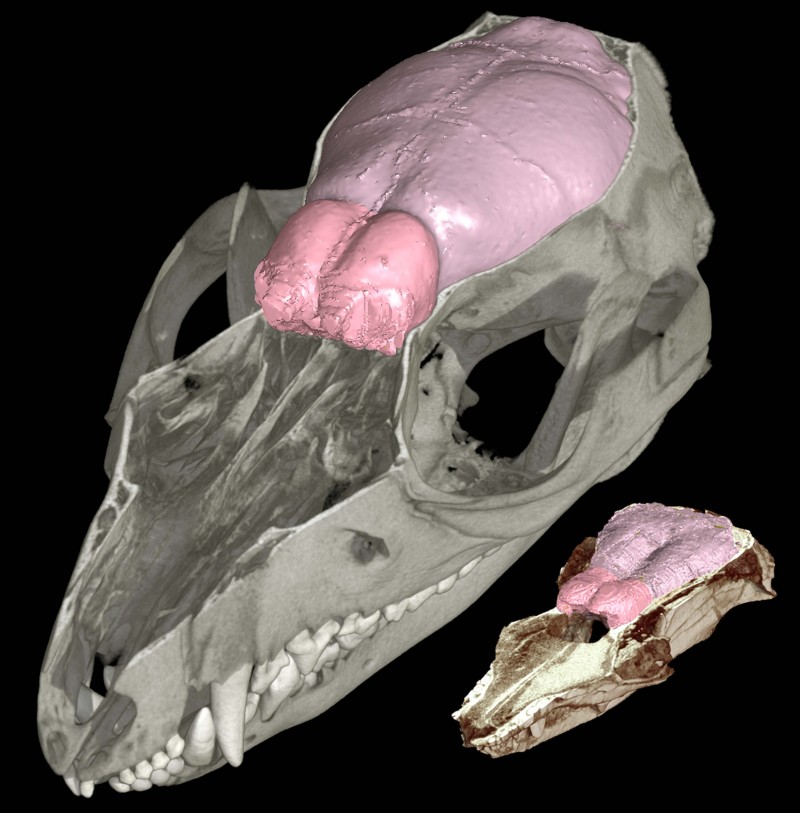
CT scans of modern short-tailed opossum (upper left) and Hadrocodium (bottom right) brains (pink) through cut-away skulls. Olfactory bulbs are at front of brain (reddish pink). Credit: Matt Colbert
AUSTIN, Texas — Mammals first evolved their characteristic large brains to enable a stronger sense of smell Carnegie Museum of Natural History and St. Mary's University in San Antonio. This latest study is the first to use CT technology, similar to medical scanners, to reconstruct the brains of two of the earliest known mammal species, both from the Jurassic fossil beds of China. The 3-D scans revealed that even these tiny, 190-million-year-old animals had developed brains larger than expected for specimens of their period, particularly in the brain area for smell. Among living animals, mammals have the largest brains relative to body size. Scientists have proposed many explanations, but because fossil skulls of early mammals are extremely rare, have been reluctant to cut them open for closer study, thus destroying the fossils. Scientists have mostly relied on comparative studies of living mammals. "We studied the outside features of these fossils for years," said Tim Rowe, professor in the Jackson School of Geosciences and director of the Vertebrate Paleontology Laboratory at The University of Texas at Austin, and lead author of the new study.
TO READ THIS ARTICLE, CREATE YOUR ACCOUNT
And extend your reading, free of charge and with no commitment.