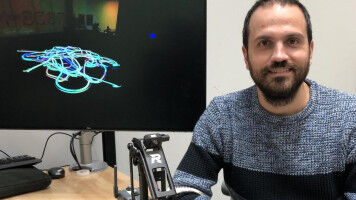
His retirement in fall 2025 marks the end of a formative chapter in Swiss organ research.
From oil to the organ
When Marco Brandazza talks about his career, he covers a wide range of topics, from the rock strata of the Italian Riviera to the pipes and windchests of central Switzerland. The Italian-born paleontologist and later organist is a personality who combines science and music.
"My doctorate was about 20,000 shells from the Pliocene in Albenga," he says with a smile. At the time, he was researching at the interface between palaeontology and petroleum geology, until love took him in a different direction.
After completing his military service in Savona, he followed his partner Eva to Switzerland. Eva, a Zurich native, was spending her summers in Varigotti at the time, where the two met. "She gave me a choice: Helicopter or her," he says with a laugh. At the time, he was working on oil rigs off the Adriatic. He chose her, Switzerland and music.
A new start in Lucerne
A new phase of his life began in Lucerne. Brandazza was given the opportunity to audition for the internationally renowned organist Monika Henking. "I couldn’t speak a word of German, but she said: I can do something with you."
He studied organ, church music, conducting and later Gregorian chant and eventually became assistant to Alois Koch at the Jesuit Church in Lucerne.
He retained his scientific way of thinking. "I probably wasn’t that untalented," he says dryly. He soon combined analytical precision with musical sensitivity. A combination that would later become the basis of his work in the organ business: the Organ Documentation Center (ODZ).
The birth of the Organ Documentation Center
"It was a difficult start," Brandazza recalls. The university was in a phase of upheaval and funding was uncertain. But with perseverance, patience and persuasion, he managed to win over the heritage offices of various cantons: first Lucerne, then Zug, Schwyz, Uri and finally Ticino.
His goal: to systematically record Switzerland’s organs, document them scientifically and make their history comprehensible. "We work seriously and comprehensibly," he emphasizes. Today, the ODZ is regarded as an important reference point for organ research in Switzerland.
Research with passion
Brandazza is proud of the thoroughness of his work, but also knows that it is not always easy to communicate in an artistic environment. "In the organ world, scientific research is sometimes viewed with caution," he says. It is important to him to remain independent and to base projects on a solid foundation. An approach that has earned him the trust of many specialist bodies and heritage offices over the years.
"I always wanted our work to be verifiable and transparent," he explains. This aspiration also shapes his database: it now documents over 500 organs from Central Switzerland, each individually checked, described and archived.
The art of precision
The work of the ODZ is based on a checklist that was developed at the University of Zurich in the 1980s. Brandazza has developed it further and supplemented it with meticulous archival work.
"We go into every archive and compare everything with the existing literature," he says. For example, he was able to prove for the first time who had built the organ at St. Michael’s Church in Zug in 1504. A discovery that was only possible thanks to patient research in old council minutes.
But Brandazza knows that organs live on. "You can count all the cars in a garage, but no one can guarantee that they will still be there in a year’s time," he says with a smile. His research also remains in flux.
A European spirit with a Swiss heart
After 38 years in Switzerland, Brandazza retired at the end of September. Even after his active time at the university, he wants to remain connected to the organ world as a researcher, consultant and musician.
At the end of the interview, Brandazza talks about the future of the musical landscape: "In order to feel European, you sometimes lose what has made Switzerland strong: its diversity, its idiosyncrasies."
He says this without bitterness, but emphatically. For him, diversity - whether in science, music or culture - is a value that must be preserved.
The Organ Documentation Center (ODZ)
The Organ Documentation Center of the Lucerne University of Applied Sciences and Arts records, researches and documents organs in Switzerland. In close cooperation with heritage offices and specialist agencies, the ODZ collects historical, technical and tonal data and makes it available to researchers and the public. Today it is the central point of contact for scientific organ research in Switzerland.
www.orgeldokumentationszentrum.ch