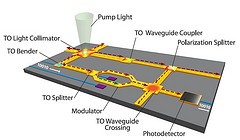
Credit: Douglas Werner Transformation optics devices that perform diverse, simple functions can be integrated together to build complex photonic systems for optical communications, imaging, computing and sensing.
UNIVERSITY PARK, Pa. — Using a combination of the new tools of metamaterials and transformation optics, engineers at Penn State have developed designs for miniaturized optical devices that can be used in chip-based optical integrated circuits, the equivalent of the integrated electronic circuits that make possible computers and cellphones. Controlling light on a microchip could, in the short term, improve optical and allow sensing of any substance that interacts with electromagnetic waves. In the medium term, optical integrated circuits for infrared imaging systems are feasible. Further down the road lies high-speed all-optical computing. The path forward requires some twists on well-known equations and the construction of structures smaller than the wavelength of light. Light bends naturally as it crosses from one material to another, a phenomenon called refraction that can be seen in the way a stick seems to bend in water.
TO READ THIS ARTICLE, CREATE YOUR ACCOUNT
And extend your reading, free of charge and with no commitment.