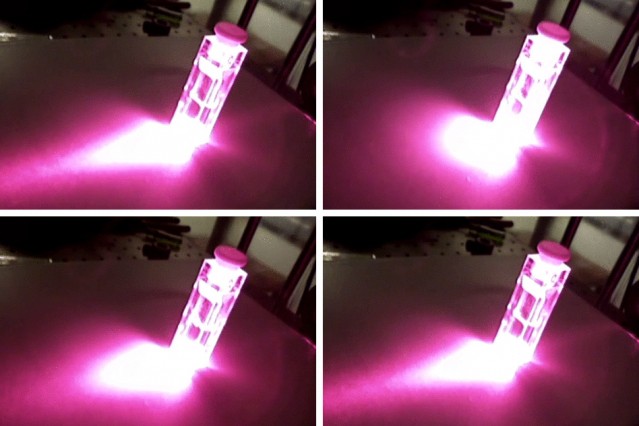
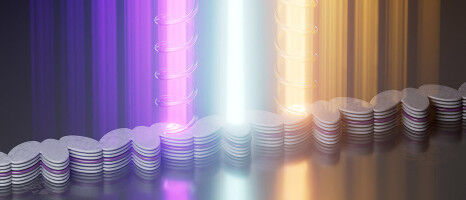
A mild temperature change radically alters the degree to which a solid-fluid mixture bends light.
By immersing glass particles in a fluid, researchers at MIT's Media Lab and Harvard University are exploring a new mechanism for modifying an optical device's diffusivity, or the extent to which it scatters light. In its current form, the new diffuser could be used to calibrate a wide range of imaging systems, but the researchers believe that their mechanism could ultimately lead to holographic video screens or to tunable optical devices with applications in imaging, sensing, and photography. In experiments, the solid-liquid mixture demonstrated much more dramatic changes in diffusivity than existing theory would have predicted, so the researchers also developed a new computer model to describe it. That model could help them devise more complex applications for the basic technology. The researchers describe their new work in the latest issue of the American Chemical Society's ACS Photonics journal. The fluid and the glass in the prototype were chosen because they have very similar refractive indices, meaning light travels through them at similar speeds. When light moves from a material with a high refractive index to one with a lower refractive index, it changes direction; this is the phenomenon behind the familiar illusion of a straw's appearing to bend when it's inserted into a glass of water.
TO READ THIS ARTICLE, CREATE YOUR ACCOUNT
And extend your reading, free of charge and with no commitment.