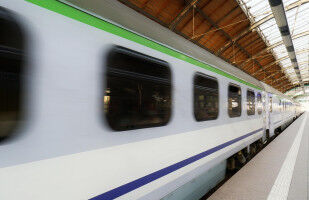
The Thüringer Innovationszentrum Mobilität at the Technische Universität Ilmenau has launched a large-scale joint research project that promises greater safety for autonomous driving on roads and railways in complex environments. In the CONTROL project, 24 partners from research and industry, under the management of Siemens AG and Valeo Schalter und Sensoren GmbH, will develop innovative methods for the safe driving of autonomous vehicles in dynamic overall road and rail systems. The costs of the three-year, 30 million euro project are being funded by the Federal Ministry for Economic Affairs and Energy to the tune of 16 million euros.
www.control-projekt.de
How can autonomous cars, trucks, buses and trains drive safely and reliably when traffic conditions are constantly changing due to unexpected obstacles or changing weather conditions? This question is at the heart of the research project CONTROL, short for "Controlling Risk of Highly Automated Transportation Systems Operating in Complex Open Environments", which was launched in October.
Autonomous driving is regarded as a key technology for the mobility of the future. It promises greater road safety, higher fleet efficiency, lower emissions, a more sparing use of resources and more comfort. Above all, however, it promises new mobility services, such as autonomous people movers, i.e. automated vehicles for transporting passengers in scheduled and on-demand services, automated trucks and driverless trains.
However, the automated vehicles that are already in use today only work under clearly defined environmental conditions. What is missing is the ability to operate safely in an open, highly dynamic traffic environment with changing external conditions.
CONTROL research project - for safe mobility under constantly changing conditionsThis is precisely where the CONTROL research project comes in and promises to master such scenarios: so-called long-tail events such as unexpected obstacles on the road and rail, restricted visibility, suddenly changing light conditions or changing weather. Such events can have a significant impact on driving safety. Mastering them is therefore crucial for safe autonomous driving in every conceivable driving situation.
24 partners are involved in the CONTROL project under the leadership of Siemens AG and Valeo Schalter und Sensoren GmbH, including the Thüringer Innovationszentrum Mobilität (ThIMo) at TU Ilmenau. Over the next three years, experts from research and industry will develop innovative methods for safeguarding autonomous vehicles as part of the overall dynamic road and rail systems. The vehicles will be able to systematically detect and evaluate uncertainties in real time while driving and, if necessary, initiate measures to ensure driving safety, such as adjusting speed or taking controlled evasive action. All results of the CONTROL project are validated in simulations and their practical suitability is tested in test vehicles of the partners involved.
Thuringian Mobility Innovation Center - Technology for safe autonomous driving in ThuringiaThe scientists working in radio and information technology - a core competence of the Thüringer Innovationszentrum Mobilität - at TU Ilmenau have the special task of completing the test chain between real driving tests and computer-aided simulations. A new method is being used that integrates the sensor systems to be tested into a real test chain. This test procedure developed at ThIMo, which experts call over-the-air vehicle-in-the-loop, is now being marketed worldwide via industrial partners.
While the application of the test procedure is the focus of research at the TU Ilmenau RF and Microwave Research Group, the research focus of the ThIMo scientists in the Radio Technologies for Automated and Connected Vehicles Group is on modeling realistic radar sensors. Professor Matthias Hein, ThIMo Director and head of the RF and Microwave Research Group, sees the federal CONTROL project as hugely important for the Free State of Thuringia: "The project is creating the technological prerequisites for safe autonomous systems that will be applied across the board in the Thuringia model region for automated and connected driving in public transport and will modernize local public transport in particular in the long term."
The CONTROL project will not only strengthen the technological sovereignty and international competitiveness of German industry in the field of autonomous mobility, it will also create an important basis for new standards and products on road and rail and in fields of application for autonomous systems beyond: for example, industrial automation and robotics.