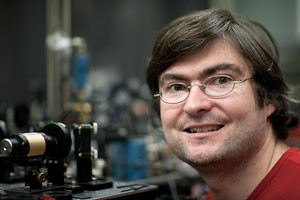
Holger
Müller
BERKELEY — While airplane and rocket experiments have proved that gravity makes clocks tick more slowly — a central prediction of Albert Einstein's general theory of relativity — a new experiment in an atom interferometer measures this slowdown 10,000 times more accurately than before, and finds it to be exactly what Einstein predicted. "This experiment demonstrates that gravity changes the flow of time, a concept fundamental to the theory of general relativity," Müller said. The phenomenon is often called the gravitational redshift because the oscillations of light waves slow down or become redder when tugged by gravity. Müller tested Einstein's theory by taking advantage of a tenet of quantum mechanics: that matter is both a particle and a wave. The cesium atoms used in the experiment can be represented by matter waves that oscillate 3x1025 times per second, that is, 30 million billion billion times per second. When the cesium atom matter wave enters the experiment, it encounters a carefully tuned flash of laser light. The laws of quantum mechanics step in, and each cesium atom enters two alternate realities, Müller said.
TO READ THIS ARTICLE, CREATE YOUR ACCOUNT
And extend your reading, free of charge and with no commitment.