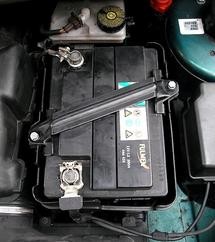
Starter turn: lead-acid battery is mysterious. Photo: Phil Parker
Chemists have solved the 150 year-old mystery of what gives the lead-acid battery, found under the bonnet of most cars, its unique ability to deliver a surge of current. Lead-acid batteries are able to deliver the very large currents needed to start a car engine because of the exceptionally high electrical conductivity of the battery anode material, lead dioxide. However, even though this type of battery was invented in 1859, up until now the fundamental reason for the high conductivity of lead dioxide has eluded scientists. A team of researchers from Oxford University, the University of Bath, Trinity College Dublin, and the ISIS neutron spallation source, have explained for the first time the fundamental reason for the high conductivity of lead dioxide. A report of the research appears in this week's Physical Review Letters . 'The unique ability of lead acid batteries to deliver surge currents in excess of 100 amps to turn over a starter motor in an automobile depends critically on the fact that the lead dioxide which stores the chemical energy in the battery anode has a very high electrical conductivity, thus allowing large current to be drawn on demand,' said Professor Russ Egdell of Oxford University's Department of Chemistry, an author of the paper. 'However the origin of conductivity in lead oxide has remained a matter of controversy.
TO READ THIS ARTICLE, CREATE YOUR ACCOUNT
And extend your reading, free of charge and with no commitment.