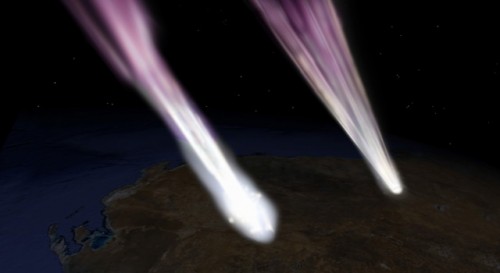
This artist’s concept depicts the Hayabusa spacecraft (left) and sample return capsule (right) entering the atmosphere over South Australia. Image credit: NASA/JPL
The space and astronomy worlds have June 13 circled on the calendar. That's when the Japan Aerospace Exploration Agency (JAXA) expects the sample return capsule of the agency's technology demonstrator spacecraft, Hayabusa, to boomerang back to Earth. The capsule, along with its mother ship, visited a near-Earth asteroid, Itokawa, five years ago and has logged about 2 billion kilometers (1.25 billion miles) since its launch in May 2003. With the return of the Hayabusa capsule, targeted for June 13 at Australia's remote Woomera Test Range in South Australia, JAXA will have concluded a remarkable mission of exploration - one in which NASA scientists and engineers are playing a contributing role. "Hayabusa will be the first space mission to have made physical contact with an asteroid and returned to Earth," said Tommy Thompson, NASA's Hayabusa project manager from the Jet Propulsion Laboratory in Pasadena, Calif. "The mission and its team have faced and overcome several challenges over the past seven years. This round-trip journey is a significant space achievement and one which NASA is proud to be part of." Launched May 9, 2003, from the Kagoshima Space Center, Uchinoura, Japan, Hayabusa was designed as a flying testbed.
TO READ THIS ARTICLE, CREATE YOUR ACCOUNT
And extend your reading, free of charge and with no commitment.