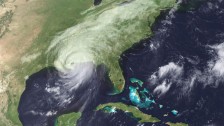
Hurricane Katrina makes landfall in the US. Speaking this week in Cambridge, engineer Tom O’Rourke will describe such disasters as game-changers for those wishing to protect people from similar, future events. Credit: NASA.
The talk will examine the threat posed by potential future earthquakes to the water supply of Southern California, or that of hurricanes to New York City." - Some of the worst natural disasters of the last decade have radically changed the ways in which we strive to protect communities from similar, future tragedies, a leading engineer will explain this week. Citing a roll-call that includes the Tohoku earthquake and tsunami, the Canterbury earthquake and Hurricanes Katrina and Sandy, Professor Tom O'Rourke of Cornell University will argue that these and other similarly devastating incidents have established a "new normal" for the way in which we prepare ourselves for extreme events. He will be speaking at the inaugural lecture of the Cambridge Centre for Smart Infrastructure and Construction (CSIC). This marks the formal commencement of a multitude of new research projects on infrastructure, many of which are designed to enable society to protect critical infrastructure from the unexpected. The lecture will take place in the Department of Engineering, University of Cambridge, on 17 January, at 6pm. Researchers at the Centre are already developing and improving wireless technologies, fibre optics and other types of sensors, with a view to establishing them as the norm for the construction industry and those in asset management responsible for monitoring bridges, tunnels, roads, railways, and other types of infrastructure.
TO READ THIS ARTICLE, CREATE YOUR ACCOUNT
And extend your reading, free of charge and with no commitment.