Innovation and creativity are key drivers of economic growth and therefore of Switzerland’s prosperity. With the Cantonal Innovation and Creativity Index (KIKI), the Lucerne University of Applied Sciences and Arts has developed an instrument that enables a well-founded comparison of the cantons for the first time.
With the Cantonal Innovation and Creativity Index (KIKI), the Lucerne University of Applied Sciences and Arts is presenting an analysis model that can be used to measure innovation and creativity in cantons. ’The KIKI is the first cantonal index that evaluates these key skills regionally and in detail,’ says Christoph Hauser, Professor at the Institute of Business and Regional Economics at Lucerne University of Applied Sciences and Arts and author of the index.
The KIKI consists of a weighted sum of 101 individual indicators, which have been grouped into four thematic areas ’Knowledge and Environment’ and ’Creation and Growth’ with a total of eight thematic pillars (see box). Data sources include the Federal Statistical Office (FSO), the Federal Finance Administration, the federal innovation agency Innosuisse, the OECD and the Swiss Federal Institute of Intellectual Property.
Canton Zug in the top spot
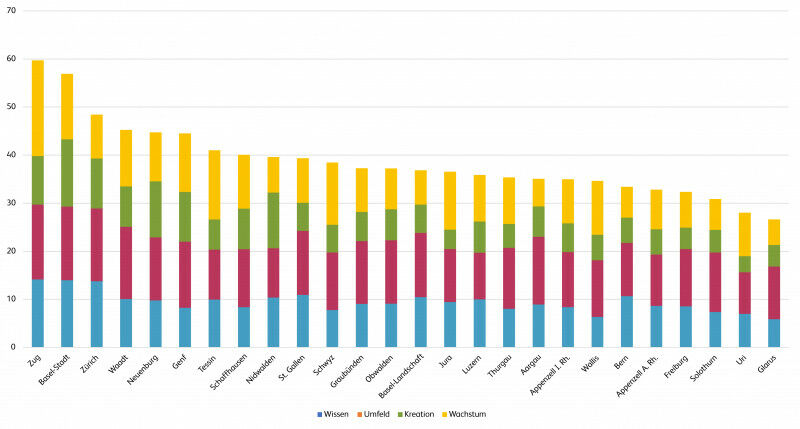
The researchers used the KIKI to compile a ranking list for the cantons of Switzerland (see Figure 1). Based on the data for 2024, the canton of Zug takes first place with just under 60 out of 100 theoretically possible points, followed by Basel-Stadt and Zurich. The cantons of Vaud, Neuchâtel and Geneva are close behind in fourth to sixth place. This is followed by a broad midfield with scores between 31 and 41.
Zug leads the field in the areas of knowledge, creation and growth. Basel-Stadt has the highest score for creation and is in second or third place for the other indicators. The third-placed canton of Zurich is well ahead everywhere except for growth.
’The cantons at the bottom of the rankings still achieve almost half of Zug’s points, which is respectable given the high level,’ says Christoph Hauser. Especially when you consider that Switzerland is considered the most innovative country in the world according to the Global Innovation Index, which means that the entire evaluation is at a very high level. Uri can show good growth despite otherwise lower indicators. Glarus mainly scores highly in various supporting factors. For example, the canton has a lot of recreational value and is nevertheless in an urban area of influence.
’The KIKI shows how innovation and creativity are expressed in many different ways,’ says Christoph Hauser. There is therefore no single, simple means of promoting it. ’But cultivating innovation and creativity is obviously worthwhile. We were surprised to see how closely the KIKI correlates with the economic strength of the cantons.
The eight pillars of KIKI
The Global Innovation Index (GII) has been a comparable index at global level for several years now. Switzerland has repeatedly taken first place in this index. The KIKI is based on the GII and consists of various indicators that are grouped into "input" and "output". Input factors are those that promote innovation and creativity, while output factors measure the impact of innovation and creativity. Both dimensions each contain two subgroups, namely knowledge and environment (input) and creation and growth (output). These in turn each contain two, i.e. a total of eight pillars. Each pillar takes into account between 8 and 20 individual indicators, which are weighted equally within the pillar. The pillars correspond to important input and output factors for innovation and creativity that have been confirmed in the scientific literature.
- The education and educational success pillar contains various indicators on supply, take-up and success rates in the education sector. Broadly diversified and utilized education is the basis of human capital and the skills and abilities that are essential for creative and innovative processes.
- The research, development and knowledge pillar contains various statistics on the activities of the Swiss Innovation Agency Innosuisse and on public research expenditure. A high proportion of technology and knowledge-intensive industries and services also indicates a strong research base.
- The diversity pillar describes the diversity of a society in terms of ethnic origin, gender, religion, language and cultural background as well as the inclusion of different social groups in the labor market. A diverse population brings a wide range of perspectives, experiences and skills to the innovation process and leads to more diverse creativity.
- The supporting factors pillar includes social, political, legal and economic conditions that can favor (or inhibit) innovation. These include spatial infrastructure, environmental conditions and tax and financial incentives for companies and individuals. One example is the possibility of deducting research expenses from profit tax.
- The pillar of art and culture is included in the KIKI, as it plays a key role in the development and promotion of creativity. This pillar covers a society’s creative forms of expression and their institutional promotion, including state and private cultural expenditure and the importance of creative sectors in economic life.
- The patents, trademarks and designs pillar relates to the protection and exploitation of intellectual property through patents, trademarks and designs. Intellectual property is a key factor in the economic success of innovations, as it enables inventors and designers to legally protect their creations and profit from them economically.
- The companies and start-ups pillar covers the practical implementers of innovations. This pillar covers start-up activity, the growth of companies and the contribution of young and fast-growing companies to job creation and economic development.