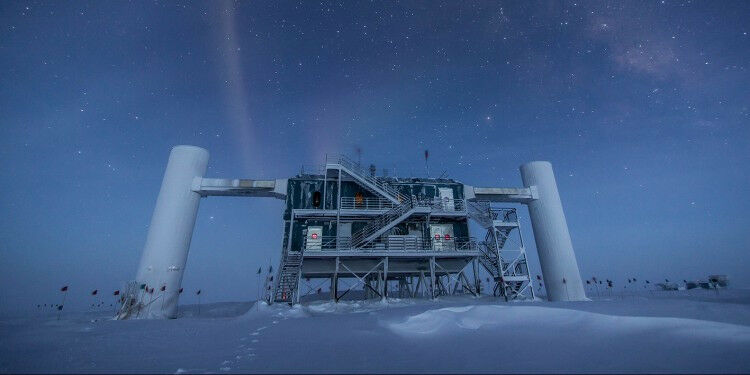
 The IceCube laboratory at the Amundsen-Scott South Pole Station in Antarctica houses the computers that collect the raw data.
"IceCube" spokesperson Ignacio Taboada reports on the progress of the experiment. The IceCube laboratory at the Amundsen-Scott South Pole Station in Antarctica houses the computers that collect the raw data. Felipe Pedreros, IceCube/NSF Researchers from several countries are using the IceCube experiment to search for neutrinos in the ice at the South Pole. These difficult-to-detect particles reach Earth from the cosmos. About 220 of the physicists involved in the experiment meet for the first time at the University of Münster from 18 to 22 March for the spring meeting of the IceCube collaboration. The meeting is hosted by Prof Alexander Kappes and his working group at the Institute for Nuclear Physics at the University of Münster. On this occasion, Christina Hoppenbrock interviewed the spokesperson of the IceCube collaboration, Prof Ignacio Taboada from the Georgia Institute of Technology, USA, about the challenges of neutrino research and the progress of the experiment.
TO READ THIS ARTICLE, CREATE YOUR ACCOUNT
And extend your reading, free of charge and with no commitment.
Your Benefits
- Access to all content
- Receive newsmails for news and jobs
- Post ads