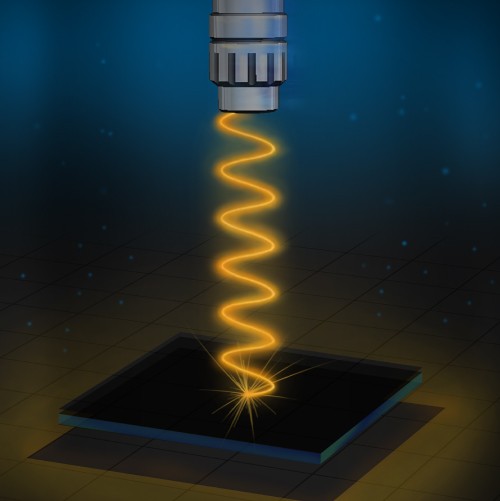
Artist’s rendition of the experimental setup used to measure the reflectivity of the vanadium-sapphire device. (Modified from an illustration by Kirill Nadtochiy.)
: Caroline Perry , (617) 496-1351 Now you see it, now you don't. A new device invented at the Harvard School of Engineering and Applied Sciences (SEAS) can absorb 99.75% of infrared light that shines on it. When activated, it appears black to infrared cameras. Composed of just a 180-nanometer-thick layer of vanadium dioxide (VO2) on top of a sheet of sapphire, the device reacts to temperature changes by reflecting dramatically more or less infrared light. Announced today in the journal Applied Physics Letters , and featured on its cover, this perfect absorber is ultrathin, tunable, and exceptionally well suited for use in a range of infrared optical devices. Perfect absorbers have been created many times before, but not with such versatile properties. In a Fabry-Pérot cavity, for instance, two mirrors sandwich an absorbing material, and light simply reflects light back and forth until it's mostly all gone.
TO READ THIS ARTICLE, CREATE YOUR ACCOUNT
And extend your reading, free of charge and with no commitment.