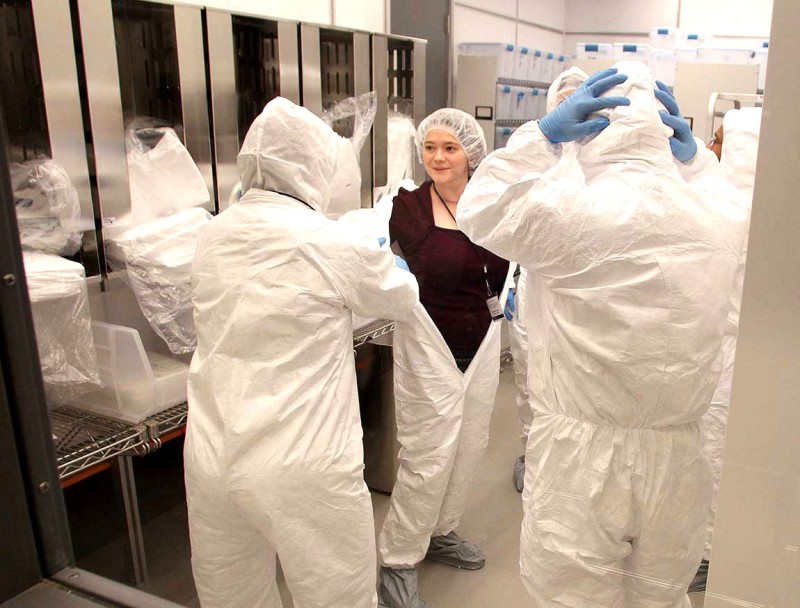
On Oct. 26, visitors toured the new imaging and fabrication facilities the Princeton Institute for the Science and Technology of Materials (PRISM) now housed in the Andlinger Center for Energy and the Environment. The new laboratories are open to researchers from outside of Princeton as well as to scientists across the University such as Caroline Krauter (center), a postdoctoral research fellow in mechanical and aerospace engineering. (Photo by Frank Wojciechowski, Office of Engineering Communications)
New facility reveals atomic details, spurs discoveries with global value. Posted October 28, 2016; 11:45 a.m. by Adam Hadhazy for the Office of Engineering In pursuit of computers that harness the power of quantum mechanics, Andrew Houck carves sapphires into wafers thinner than a human hair and uses them to trap single particles of light. To do this, Houck must peer into the sapphire at the atomic level, a feat that he said requires "a shocking degree of precision." Houck, a professor of electrical engineering , performs much of the work at the Princeton Institute for the Science and Technology of Materials (PRISM) . It is the kind of science and engineering made possible by recent upgrades to PRISM's Imaging and Analysis Center (IAC) and Micro/Nano Fabrication Laboratory (MNFL). "Having a central facility for characterizing and fabricating materials is absolutely critical for many areas of research," said Craig Arnold , director of PRISM and a professor of mechanical and aerospace engineering. "It's not just materials science — it's energy, it's environment, it's health, it's security." Speaking at a daylong event Oct. 26 to inaugurate the new facilities, Arnold said that major investments by the University have made the imaging center and fabrication lab among the best in the world and perhaps unique in their "one-stop-shop" combination of analysis and fabrication.
TO READ THIS ARTICLE, CREATE YOUR ACCOUNT
And extend your reading, free of charge and with no commitment.