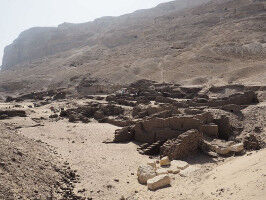
At this excavation site at the foot of Ambarlikaya in Bogazköy-Hattusha in Turkey, a cuneiform tablet with a previously unknown Indo-European language was discovered. (Image: Andreas Schachner / Deutsches Archäologisches Institut)
At this excavation site at the foot of Ambarlikaya in Bogazköy-Hattusha in Turkey, a cuneiform tablet with a previously unknown Indo-European language was discovered. (Image: Andreas Schachner / Deutsches Archäologisches Institut) - An excavation in Turkey has brought to light an unknown Indo-European language. Professor Daniel Schwemer, an expert for the ancient near east from Würzburg, is involved in investigating the discovery. The new language was discovered in the UNESCO World Heritage Site Bogazköy-Hattusha in north-central Turkey. This was once the capital of the Hittite Empire, one of the great powers of Western Asia during the Late Bronze Age (1650 to 1200 BC). Excavations in Bogazköy-Hattusha have been going on for more than 100 years under the direction of the German Archaeological Institute. The site has been a UNESCO World Heritage Site since 1986; almost 30,000 clay tablets with cuneiform writing have been found there so far.
TO READ THIS ARTICLE, CREATE YOUR ACCOUNT
And extend your reading, free of charge and with no commitment.