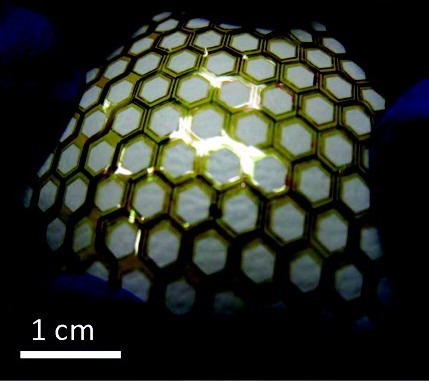
Optical image of flexible and stretchable thin film transistor array covering a baseball shows the mechanical robustness of this backplane material for future plastic electronic devices.
Imprinting electronic circuitry on backplanes that are both flexible and stretchable promises to revolutionize a number of industries and make "smart devices" nearly ubiquitous. Among the applications that have been envisioned are electronic pads that could be folded away like paper, coatings that could monitor surfaces for cracks and other structural failures, medical bandages that could treat infections and food packaging that could detect spoilage. From solar cells to pacemakers to clothing, the list of smart applications for so-called "plastic electronics" is both flexible and stretchable. First, however, suitable backplanes must be mass-produced in a cost-effective way. Researchers with the U.S. Department of Energy (DOE)'s Lawrence Berkeley National Laboratory (Berkeley Lab) have developed a promising new inexpensive technique for fabricating large-scale flexible and stretchable backplanes using semiconductor-enriched carbon nanotube solutions that yield networks of thin film transistors with superb electrical properties, including a charge carrier mobility that is dramatically higher than that of organic counterparts. To demonstrate the utility of their carbon nanotube backplanes, the researchers constructed an artificial electronic skin (e-skin) capable of detecting and responding to touch.
TO READ THIS ARTICLE, CREATE YOUR ACCOUNT
And extend your reading, free of charge and with no commitment.