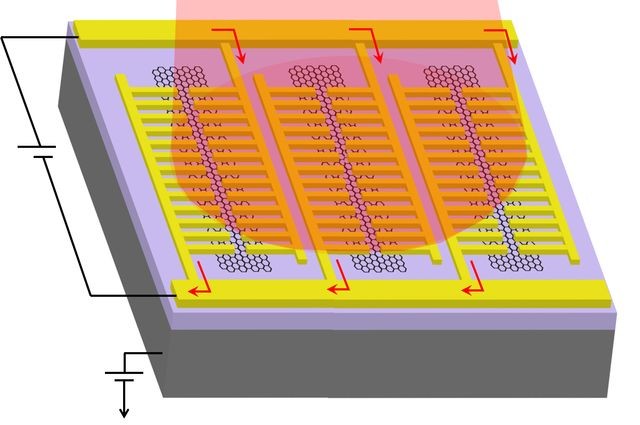
Jarrahi Research Group/UCLA
The photodetector operates across a broad range of light, processes images more quickly and is more sensitive to low levels of light than current technology.
UCLA's design eliminates tradeoffs between bandwidth, sensitivity, and speed that are common in current technology. Matthew Chin - Using graphene, one of science's most versatile materials, engineers from the UCLA Samueli School of Engineering have invented a new type of photodetector that can work with more types of light than its current state-of-the-art counterparts. The device also has superior sensing and imaging capabilities. Photodetectors are light sensors; in cameras and other imaging devices, they sense patterns of elementary particles called photons, and create images from those patterns. Different photodetectors are built to sense different parts of the light spectrum. For example, photodetectors are used in night vision goggles to sense thermal radiation that is invisible to the naked eye. Others are used in cameras that identify chemicals in the environment by how they reflect light.
TO READ THIS ARTICLE, CREATE YOUR ACCOUNT
And extend your reading, free of charge and with no commitment.