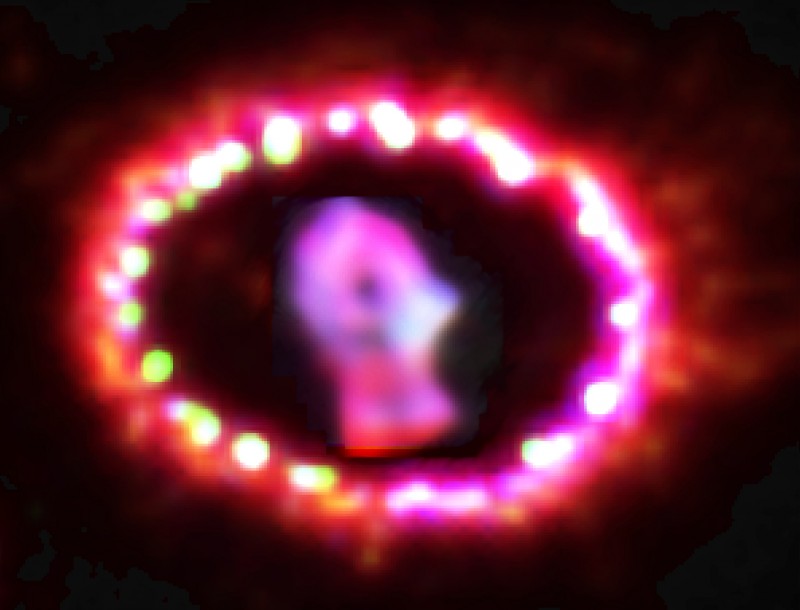
SN 1987A
Cambridge, MA - In 1987, light from an exploding star in a neighboring galaxy, the Large Magellanic Cloud, reached Earth. Named Supernova 1987A, it was the closest supernova explosion witnessed in almost 400 years, allowing astronomers to study it in unprecedented detail as it evolves. Today a team of astronomers announced that the supernova debris, which has faded over the years, is brightening. This shows that a different power source has begun to light the debris, and marks the transition from a supernova to a supernova remnant. "Supernova 1987A has become the youngest supernova remnant visible to us," said Robert Kirshner of the Harvard-Smithsonian Center for Astrophysics (CfA). Kirshner leads a long-term study of SN 1987A with NASA's Hubble Space Telescope. Since its launch in 1990, Hubble has provided a continuous record of the changes in SN 1987A.
TO READ THIS ARTICLE, CREATE YOUR ACCOUNT
And extend your reading, free of charge and with no commitment.