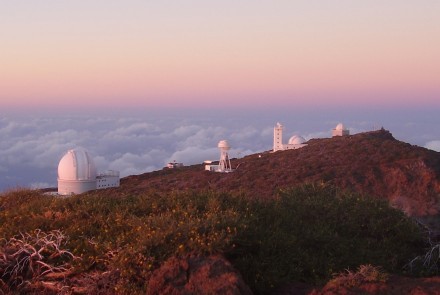
The Isaac Newton telescope in the Canary Islands. Image courtesy Luca Casagrande
Reconstructing the history of our Galaxy has just become a whole lot easier, thanks to a team of international astronomers led by Dr Luca Casagrande from the ANU. By examining both the light and soundwaves from stars, the team has developed a more precise way to deduce the ages of stars and to pinpoint when our Galaxy's big events happened. The development will help astronomers study the properties of ancient stars and help them better understand the formation and evolution of the Milky Way. "We might also uncover evidence for violent events in the past, such as collisions with other galaxies," Dr Casagrande said. Exactly how a giant prehistoric gas cloud condensed to form the stars and planets of our Galaxy, and why it formed its familiar spiral shape, are the kind of questions Dr Casagrande's team are addressing. Until now, a celestial version of the carbon-dating used by terrestrial archaeologists has been missing. That is now changing, thanks to Dr Casagrande's approach, which harnesses the light and sounds from the stars.
TO READ THIS ARTICLE, CREATE YOUR ACCOUNT
And extend your reading, free of charge and with no commitment.