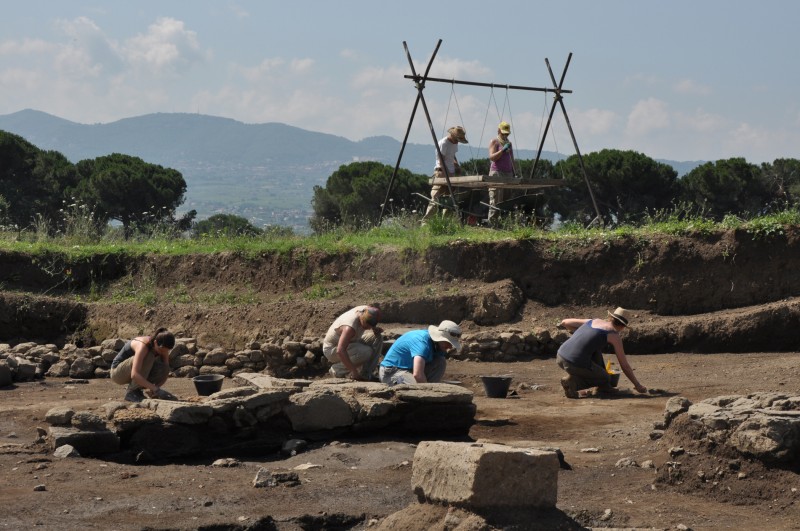
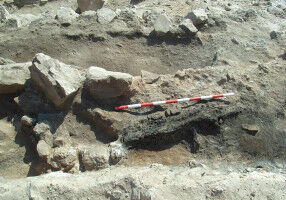
A team of 60 researchers including undergraduates and graduate students from several universities took part this summer in a major archeological dig at the site of Gabii, just outside Rome. The project, which began in 2009, is the largest American dig in Italy in the past 50 years. Images courtesy: Marcello Mogetta.
ANN ARBOR-In a long-buried Italian city, archaeologists have found a massive monument that dates back 300 years before the Colosseum and 100 years before the invention of mortar, revealing that the Romans had grand architectural ambitions much earlier than previously thought. The structure, unearthed at the site known as Gabii, just east of Rome, is built with giant stone blocks in a Lego-like fashion. It's about half the size of a football field and dates back 350-250 years BCE. It's possibly the earliest public building ever found, said Nicola Terrenato, a University of Michigan classics professor who leads the project-the largest American dig in Italy in the past 50 years. The huge complex, which might also have been an exceptionally lavish private residence, holds a stone retaining wall, geometrically patterned floors and two terraces connected by a grand staircase. It's unlike anything the Romans were thought to be building at the time, Terrenato said, and it challenges the ancient stereotype that they were at that point a modest and conservative people. "There are a lot of constructive details that are beautiful to look at and they tell us more about how the Romans were building at that stage," Terrenato said."This shows us they were beginning to experiment with modifying their natural environments-cutting back the natural slope and creating a retaining wall, for example- about a quarter of a millennium earlier than we thought.
TO READ THIS ARTICLE, CREATE YOUR ACCOUNT
And extend your reading, free of charge and with no commitment.