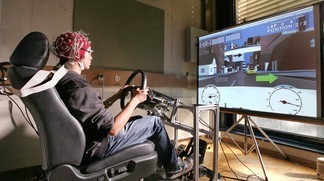
The BCI simulator used in the lab
After scanning the thought patterns of its driver, the car of tomorrow will be able to predict its next move. As the driver thinks about turning left ahead, for example, so the car will prepare itself for the manoeuvre, selecting the correct speed and road positioning, before completing the turn. The aim? To ensure that our roads are as safe as possible and that the freedom that comes with personal mobility remains at the heart of society. Nissan is undertaking this pioneering work in collaboration with the école Polytechnique Fédérale de Lausanne in Switzerland (EPFL). Far reaching research on Brain Machine Interface (BMI) systems by scientists at EPFL already allows disabled users to manoeuvre their wheelchairs by thought transference alone. The next stage is to adapt the BMI processes to the car - and driver - of the future. Professor José del R. Millán, leading the project, said: "The idea is to blend driver and vehicle intelligence together in such a way that eliminates conflicts between them, leading to a safer motoring environment." Although thought control - via brain-machine interface - is well established in the scientific world, the levels of concentration needed are exceptionally high.
TO READ THIS ARTICLE, CREATE YOUR ACCOUNT
And extend your reading, free of charge and with no commitment.