Two consortium projects involving researchers from Radboud University have received funding from NWO. Frank Filthaut is part of a project receiving over €21 million for research into accelerator physics, while Laura Scarabosio and Gabriel Lord are part of a project granted €16.5 million to build a research cluster for real-time research into energy systems.
FASTTRACK
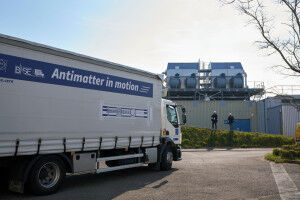
The FASTTRACK program focuses on developing new sensor techniques that enable particle detectors at CERN to record particle collisions up to fifty times faster. This acceleration is essential to disentangle the deluge of particles in the LHC accelerator as particle beams become up to ten times more intense in the coming years.
When the beams in the LHC collide, hundreds of protons interact almost simultaneously, creating thousands of new particles that pass through the detector. Reconstructing the trajectories of these particles from all the sensor signals poses a significant challenge. By increasing the recording speed, proton-proton collisions can be distinguished more clearly from each other.
The aim is that higher measurements rates will also make it possible to observe important but extremely rare particle processes, which can be used to test and refine existing particle theories. Within the research programme, Nikhef and its six university partners (Amsterdam, VU, Nijmegen, Utrecht, Maastricht, Groningen) are collaborating on everything from new chip technologies to advanced software.
UTOPYS
This consortium project called Understanding Large and cOmplex Power sYstems (UTOPYS) will enable researchers to build the world’s largest research cluster for real-time energy system studies. The new research infrastructure will be the first of its kind worldwide. It will be capable of dynamically representing the complex energy systems, allowing researchers to simulate and study the energy system of the future before building it.
This unique platform will enable investigation of crucial phenomena such as cyber-physical dynamics, hidden instability modes, complex controller interactions, swarm behaviour, and cyber vulnerabilities-all key challenges that future energy scientists must master.
Gabriel Lord: ’We are excited to be part of this large initiative and to help develop models of future power systems. In particular our role in identifying parameters form available data and to quantify uncertainty in models and predictions. This builds on our existing links with a number of power grid operators and the Alliander - Radboud alliance.’